
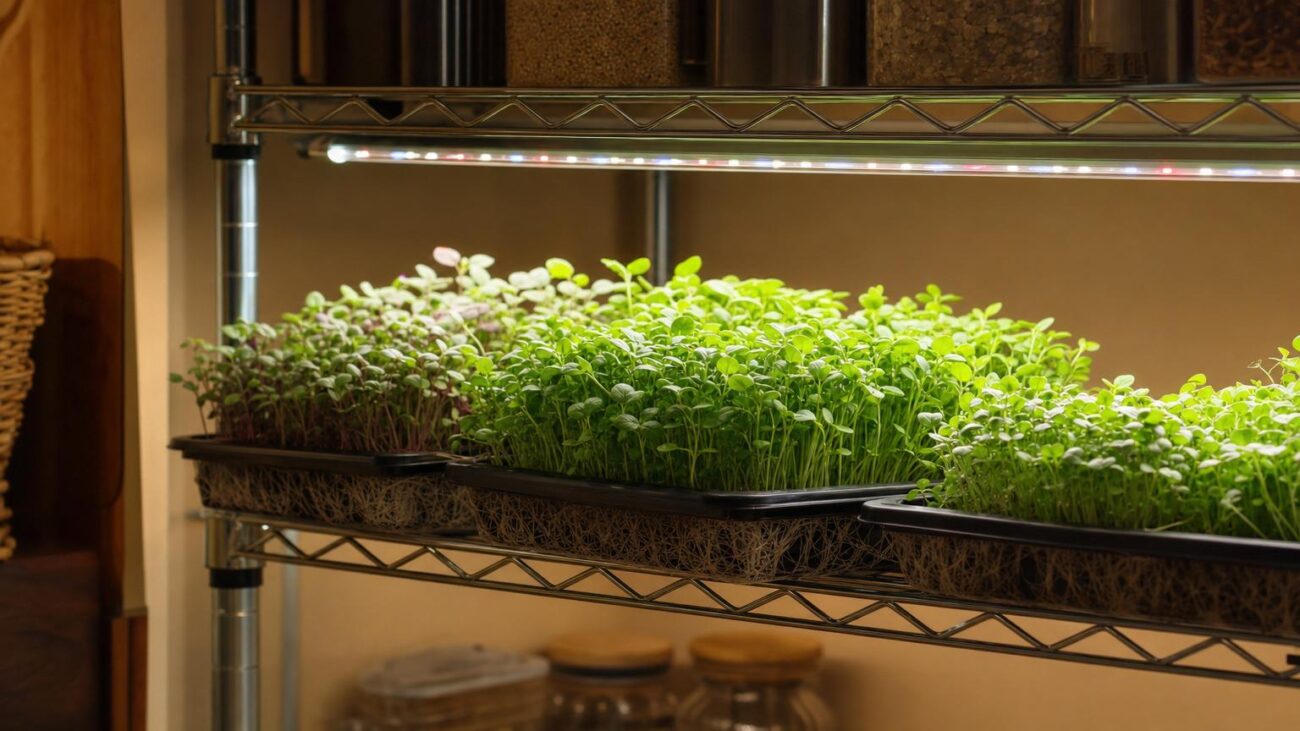
The light that fits the shelf often matters more than the light with louder specs.
A standard wire rack looks roomy until a seed tray, humidity dome, and clamp light all meet on the same shelf. Suddenly the fixture hangs too low, blocks watering, or leaves the tray corners pale while the center gets all the attention. That mismatch is common with microgreens, where shallow trays and tight vertical spacing leave very little forgiveness.
For this kind of setup, shelf geometry matters more than braggy numbers on the box. A usable light needs decent edge coverage, enough clearance to snip and rinse trays, and a shape that does not turn every harvest into a knuckle-scraping chore. In practice, the frustration is rarely “not enough grow light.” It is finding one that actually fits and works around real shelves.
- The 8.6-inch dual-head strips can suit narrow shelves with limited depth.
- The 40W ultra-thin panels may make more sense over larger trays needing broader coverage.
- The 8-inch 2-pack offers a compact option for split trays or staggered shelf space.
Shelf-friendly options at a glance


A shelf light that reaches the full tray often grows more evenly than a brighter strip that leaves the outer inch or two noticeably dim. On microgreen shelves, the most practical upgrade is often better spread, not just more intensity.
What actually matters on a microgreens shelf
-
Coverage should match the tray
Microgreens care more about even light across a shallow canopy than a bright hotspot in the middle. Long strips often suit narrow shelves better than a single square panel.
Look forA beam shape that reaches tray edges without leaving dim cornersAvoidBig output numbers paired with patchy spread -
Low-profile mounting keeps space usable
On real shelves, every inch of headroom counts. Slim fixtures and simple clips or magnets usually waste less vertical space than bulky housings and arms.
Look forThin lights that tuck close to the shelf aboveAvoidChunky bodies that steal growing clearance -
Cooler running lights are easier to live with
Shallow trays dry faster when heat builds under a shelf. A cooler fixture tends to be kinder to tight setups and less fussy about distance.
Look forModest heat and good airflow around the fixtureAvoidHot panels that warm the shelf more than expected -
Cords and adjustability affect daily use
A tidy cord path and easy height changes matter more than they seem on day one. Small shelves feel crowded fast once timers, power bricks, and tray swaps enter the picture.
Look forSimple wiring, reachable switches, and flexible hanging optionsAvoidMessy adapters and fixed setups that are hard to tweak
For most microgreens shelves, extra brightness helps less than many listings imply. Since trays are shallow and lights usually sit close, uniform coverage, workable mounting height, and manageable heat often do more for steady growth than a higher headline wattage alone.
These picks were narrowed by everyday shelf limits, not ideal grow-room conditions. Fit, sensible 10×20 coverage, and low-fuss mounting mattered more than inflated spec sheets.
Slim housings and manageable lengths were favored so lights sit neatly on real wire or wood shelving.
Each option needed to light a 10×20 tray reasonably evenly, not just blast the center.
Mounting flexibility, cord routing, and timer-friendly power setups helped separate practical choices from fussy ones.
Higher output can sound appealing, but bulky fixtures and awkward mounts often steal shelf space. For microgreens, a light that fits cleanly and covers a tray well is usually the more workable choice.
Low-profile strips for cramped shelf widths
Tiny, budget-friendly shelf grow light
These 8.6-inch dual light bars make sense when a microgreens shelf is tight, interrupted by supports, or awkward to mount around. Their slim shape slips under short shelves and into narrow spans without taking up headroom. For small trays or split shelf layouts, that flexibility can matter more than using a larger fixture. On broader shelves, though, the setup may start to feel a bit pieced together rather than cleanly covered.
- Very slim profile
- Easy around supports
- Flexible placement
- Budget-friendly entry
- Short coverage span
- Can look patchy
- More improvised on wide shelves
Quick take A practical small-space option when shelf geometry is the main challenge. It is less convincing when a broad shelf needs tidy, even-looking coverage.
For shelves with limited width or fussy supports, this style of light is a very sensible match. Its low profile and placement flexibility are the real draw. Once the shelf gets wider, however, two short bars can start to feel more like a workaround than a polished all-in-one solution.
Broad-panel coverage for larger trays
High lumen output for larger trays
This 4-panel, 40W kit makes more sense on shelves running full 10×20 trays, or slightly wider planting areas, where edge dimming stands out more quickly.
Its appeal is the wider blanket of light: a panel layout can make dense microgreens look more consistent from center to corners, instead of strongly spotlighted in the middle.
- Broad spread suits full 10×20 trays
- Thin panels fit under shelves fairly easily
- Dimming and timer help stacked setups
- Needs more planning for mounting and cable routing
- Larger footprint can eat into low-shelf clearance
- Four pieces take longer to position neatly
Quick take This style works well when uniform coverage matters more than keeping the fixture tiny. It can reduce harsh bright spots and darker tray edges, but the larger layout benefits from a little forethought.
A sensible pick for broad coverage. On microgreens shelves, the wider panel layout can soften shadows from shelf posts and reduce the bright-center, dim-edge look that narrower bars sometimes leave behind.
The compromise is setup space: more panel area means more attention to hanging height, cord slack, and harvest clearance.
Wiaxulay 2-pack for flexible small-shelf coverage
Ideal fit for plant stands and shelves
This two-strip set lands in a practical middle zone: more adaptable than a single small bar, but still easy to fit on starter racks and narrow plant shelves. Because each 8-inch light can be placed separately, it suits growers who may begin with one tray and later shuffle spacing, tray size, or shelf layout.
- Two separate light points
- Easy fit on tight shelves
- Useful for evolving layouts
- Built-in timer adds convenience
- Short strips need careful placement
- Tray edges may grow slower
- Less plug-and-play on wide trays
Quick take A handy step up from one tiny fixture. The pair gives more placement freedom, but the small footprint means coverage usually improves only after a little tweaking.
For shelves that are still changing, this set makes sense. Two independent strips are the real advantage: they can sit side by side over one tray, or spread out to cover separate zones. The tradeoff is patience—small fixtures often need a few height and spacing adjustments before tray corners keep up with the center.
A cleaner 4-foot T5 setup for wider shelving
04
Premium, high-CRI light for microgreens
These 4-foot T5 LED bulbs fit growers treating a shelf rack as a more permanent setup, not a temporary workaround. On longer shelves, the linear format makes coverage look and feel more intentional than piecing together several short bars.
They suit wider racks and standard T5-style layouts, especially where a neater, more uniform run matters as much as simple startup cost.
| Length | 4 ft |
| Power | 24W each |
| Pack | 4 bulbs |
| Light | Full spectrum |
| Color quality | CRI 95 |
| Format | T5 LED |
| Setup | Plug & play |
| Price | ~$120 |
- Clean linear coverage on wider racks
- High-CRI full-spectrum output
- Tidy fit in T5-style layouts
- 4-pack suits multi-shelf runs
- Less suited to short shelves
- Higher upfront cost
- Less placement flexibility than small bars
Quick take This is the more deliberate shelf-system option. When the rack dimensions line up, it can look cleaner and feel more purpose-built over time than smaller mix-and-match fixtures.
A sensible step up for growers who want long, even light lines across broader shelving. If the rack already suits 4-foot lighting, this format makes strong long-term sense. On very short shelves, though, the size and price can feel harder to justify.
Match the light to the shelf
What suits one 10×20 tray on a narrow wire shelf?
Short strips are often the easiest fit. The 8.6-inch dual-head strips or the 8-inch 2-pack suit shelves where uprights and low clearance make longer fixtures awkward.
What fits a wider shelf or two smaller trays?
Broad panels usually make more sense here. The 40W ultra-thin panel set tends to spread light more evenly across a full tray and throws less light off the sides.
What if headroom is tight?
Thin strips or slim panels are usually easier than bulky housings. T5 bars can still work well, but they often need a cleaner hanging plan and a bit more vertical room.
What works for low patience with mounting hardware?
Strip kits are generally less fussy to place and adjust. The 4-foot T5 setup suits shelves where chain mounting and a more permanent layout feel acceptable.
A simple shortcut helps: if the fixture is much shorter than the tray, tray edges can lag. If it is much longer than the shelf, mounting and cord routing often become the real hassle.
Setup shapes growth
Even a decent fixture struggles when it sits too high or off-center. Watch tray corners, then tweak height and placement before blaming the light.
Weak corners often improve with a small fan and a slight re-center.
Spotting uneven coverage
Microgreens Consulting compares shelf-friendly options and makes it easier to notice shadowing, hot spots, and edge loss.
For a tight rack, the 8.6-inch dual-head strips make the easiest fit. For fuller 10×20 coverage, the 40W panel set looks more settled. The 8-inch 2-pack suits small shelves that need flexible placement, while the 4-foot T5 bulbs feel tidier on wider racks and worth a higher spend. Before buying, measure shelf width, count trays, and confirm mounting points and cord routing.

Would love a true “best budget for two trays” recommendation. Not cheapest possible junk, but something normal people can buy without turning a shelving rack into a science project.
The article gets close, but I still wasn’t 100% sure whether you’d pick the 2-pack 8-inch strips or just tell people to save for the T5 setup.
The part about working clearance mattered more to me than the watt numbers, so thank you for actually saying that. So many reviews act like more power solves everything lol.
If someone only has one 10×20 tray on a wire shelf and wants to stay under about $30, which of these would you personally lean toward?
If the budget ceiling is around $30 for a single 10×20 on a wire shelf, I’d usually start with the smaller strip-style options, especially if shelf width is tight and headroom is limited.
The tradeoff is that narrow fixtures need more attention to centering and height so tray edges don’t lag. If someone wants the cleanest, easiest wide coverage, the broader or 4-foot options are nicer—but usually not the cheapest entry point.
The 8.6-inch dual-head strips looked interesting, but I’m still not convinced they’re better than just using one longer bar and being done with it.
Saving headroom is nice, sure, but if wider shelves end up feeling improvised like you said, doesn’t that basically answer the question already?
I had the same reaction at first, but on shelves with annoying uprights those little strips can fit where a longer bar just won’t. Not prettier, just more workable sometimes.
I appreciated that you talked about corner checks and airflow. People really do blame the light when the back corner of the tray is in a dead zone with zero air movement 😅
Why no clip-on lights at all? I get that they’re messy, but for apartment growers they’re everywhere and cheap.
I kind of wanted at least one “yes it’s janky but it works” option in here.
I’m still on the fence about the 4ft T5 pick because of upfront cost. Cleaner wide-rack coverage sounds great, but for a hobby grower that can be hard to justify.
If you had to leave one product out and replace it with a more budget-friendly wide-shelf option, which one would you swap?
This was refreshingly practical. “Setup shapes growth” is exactly right.
I’ve had two trays under the same light look totally different just because one was slightly off-center and a support post was casting a dumb little shadow. Very scientific, very professional, very annoying 😂