
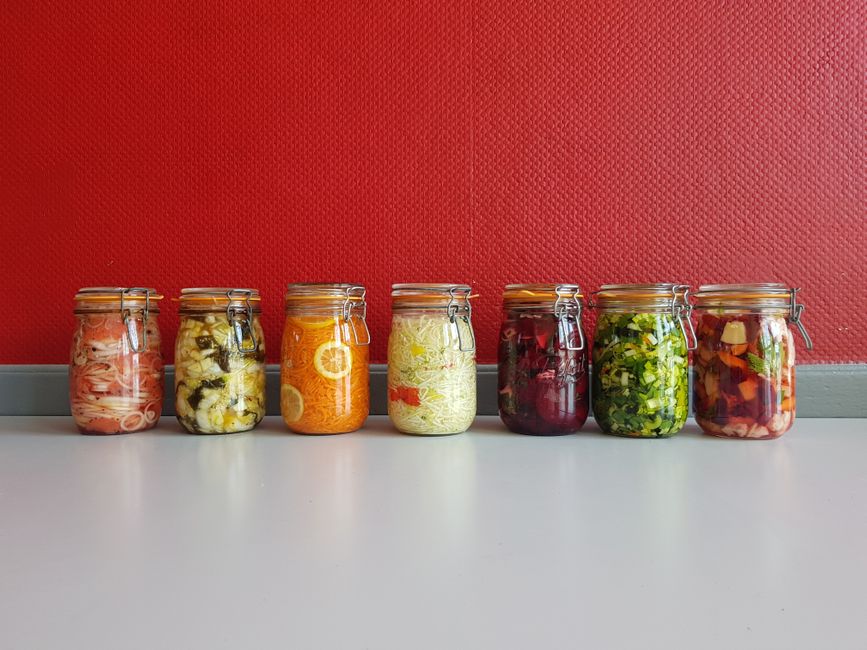
Fermentation gets easier when the kit is built around jars, weights, and lids that actually earn their space.
A first batch of sauerkraut or pickles often starts with a clean jar, a pile of chopped vegetables, and one awkward question: which parts are actually needed? Many starter kits look generous, but the extras can be less helpful than a good glass weight, a reliable airlock lid, and a jar size that suits small experiments.
For beginners, the most useful setup usually keeps things simple: wide-mouth compatibility, weights that hold food under brine, lids that release gas without daily fuss, and pieces that can be washed and reused. Small, repeatable batches matter more than a crowded box of gadgets, especially while learning how brine level, headspace, and timing change from batch to batch.
- Masontops Complete Mason Jar Fermentation Kit — a flexible top-pick option for common wide-mouth jars.
- Brillenti Mason Jar Fermentation Lids Starter Kit — a beginner-friendly lid-and-weight style kit.
- 0.6 Gallon Glass Fermentation Jars 2-Pack Kit — practical when dedicated small-batch jars are preferable.
Quick picks by use case


Kits were looked at through a practical beginner lens: the most useful sets are the ones with parts that can be washed, reused, and moved into the next batch. Decorative packaging, recipe cards, and novelty extras mattered less than whether the core pieces make small-batch fermenting easier to repeat.
Lids, airlocks or venting systems, glass weights, and sturdy jars received more attention than single-use accessories. A kit with fewer pieces could still stand out if those pieces solved common beginner problems, such as keeping vegetables submerged or reducing daily burping.
Mason-jar kits were judged partly on how clearly they fit common wide-mouth jars, since many beginners already own jars or can replace one easily. Complete jar sets were considered for batch size, storage practicality, and whether the included vessels feel useful beyond the first experiment.
The assessment focused on kit design, included components, and typical home-hobby use rather than microbial testing, pressure testing, or safety certification. Fermentation always benefits from clean handling, suitable recipes, and careful attention to spoilage signs.
Product roles reflect practical fit for beginners, not a guarantee that one kit will suit every kitchen or every ferment.
- Reusable airlock lid
A useful lid lets gas escape while keeping the jar covered, then goes back into the drawer for the next batch. Silicone pickle pipes, vented Mason-jar lids, and simple airlock tops all count when they fit common jars and clean without fuss.
- Fermentation weight
A glass or ceramic weight is one of the rare “extra” pieces that often matters, because it helps keep cabbage, cucumbers, or peppers under brine. Durable weights usually outlast labels, recipe cards, and other kit filler.
- Jar compatibility
Beginner parts are more useful when they match jars already in the kitchen, especially regular-mouth or wide-mouth Mason jars. Planning around jar size is a simple way to build a beginner fermentation setup without useless gear.
- Batch repeatability
A good starter setup makes it easy to repeat the same small batch and adjust salt, cut size, or timing with fewer variables. Kits with matched lids, weights, and jars can feel less exciting than gadget-heavy bundles, but they make learning calmer.
- Novelty clutter
Tiny tongs, decorative labels, one-off recipe booklets, and oddly specific tools can be pleasant, but they rarely carry a kit. For a first purchase, sturdy core pieces tend to age better than accessories that only look useful in the box.
Small details that make a kit easier to keep using
-
Jar fit that matches the kitchen already in use
Many lid-and-weight kits are built around wide-mouth Mason jars, but not every household has those on hand. A good fit keeps the setup simple and makes it easier to add extra jars later without buying another full kit.
Look forClear wide-mouth or jar-size compatibility before purchaseAvoidVague “fits most jars” wording with no measurements -
Venting that suits the level of attention desired
Waterless silicone valves, nipple-style lids, and airlock-style tops all release gas differently. Low-profile lids are tidy and easy to store, while airlocks make fermentation activity more visible but add pieces to clean and track.
Look forA venting style that is easy to understand and repeatAvoidTiny parts or unclear vent pieces that feel fiddly from day one -
Weights that sit low and are easy to grip
Weights help keep vegetables under brine, which can support more consistent results. Glass weights with a handle or raised grip are often less frustrating than smooth pucks, especially in narrow jar openings.
Look forThick, food-safe weights with a handle or textured lift pointAvoidWeights that look undersized, slippery, or hard to remove -
Parts that can be cleaned and replaced without drama
Fermentation gear gets salty, acidic, and sometimes strongly scented. Simple shapes, dishwasher-safe materials where stated, and replaceable lids or weights make a kit more practical after the first few batches.
Look forSmooth surfaces, few crevices, and replacement parts sold separatelyAvoidDecorative accessories that add clutter but little long-term value
A fermentation kit can lower the barrier to getting started, but it does not remove the need for basic food-handling care. Clean jars, fresh produce, proper brine coverage, and regular visual checks still matter.
For beginners, the most useful kit is often the one that makes those habits easier: parts that fit securely, clean quickly, and do not make each batch feel like a science project.
Masontops Complete Kit for reusable wide-mouth Mason jar fermenting
01
Complete kit converts jars into fermenters
Masontops Complete Mason Jar Fermentation Kit is a polished way to turn existing wide-mouth Mason jars into small fermenters, with the accessories doing most of the work. It suits beginners who already have jars on the shelf and want a tidy, repeatable setup rather than piecing together lids, weights, and a tamper one item at a time.
The appeal is less about getting new containers and more about upgrading familiar jars into a purpose-built workflow for sauerkraut, pickles, kimchi-style vegetables, or hot sauce experiments.
- Purpose-built lids and glass weights make wide-mouth jars feel more like dedicated fermenters
- Covers multiple jars at once, useful for parallel small batches
- Polished kit presentation and clear accessory pairing reduce guesswork
- Strong owner feedback and long availability add confidence for a first setup
- Costs more than basic lid-only sets at around $55
- Wide-mouth jar dependence limits use with regular-mouth jars
- Jars are not the main value if similar containers are already owned
- More pieces to wash and store than ultra-simple silicone lids
Quick take A strong overall pick for beginners who want reusable accessories that feel coordinated from the first batch. It makes most sense when wide-mouth Mason jars are already part of the kitchen.
Masontops stands out for beginners who want a neat, purpose-built accessory system rather than a pile of mismatched parts. The kit’s value is in the reusable lids, weights, and workflow pieces, not in the jars themselves.
For anyone already comfortable with wide-mouth Mason jars, it is one of the more confidence-building setups in this roundup.
A cautious first step into wide-mouth jar fermenting
No-burp waterless airlock lids
Brillenti’s starter kit keeps the setup familiar: wide-mouth Mason jars, venting lids, weights, and a small pump rather than a larger countertop vessel. That makes it approachable for someone who wants to try sauerkraut, pickles, or similar small ferments without buying a crock or a pile of specialty accessories.
The kit is built around four lids, so it fits the rhythm of small household batches: one jar on the counter, a couple of experiments going at once, or repeat batches in jars already on hand. Its usefulness depends heavily on owning the right jars, since the parts are intended for wide-mouth Mason jars rather than every jar in the cabinet.
- Waterless airlock lids can release gas without routine burping.
- Four-lid setup supports a few small jars or side-by-side experiments.
- Includes weights, so the basic lid-and-submerge pieces are covered.
- Low-profile lids are easier to store than tall airlock assemblies.
- Made with plastic lids, which may not appeal to glass-and-metal purists.
- Only useful with compatible wide-mouth Mason jars.
- Less expansive than kits that include tools, recipe books, or multiple weight styles.
- At around $50, it may feel like more than a one-time trial purchase.
Xileanalee Fermentation Kit Set for keeping extra wide-mouth batches moving
Compact parts-only kit for customization
Xileanalee’s set is a parts-only wide-mouth Mason jar kit built around the pieces that get reused most: lids, airlocks, gaskets, grommets, and glass weights. It does not include jars, which makes it a better fit for a kitchen that already has wide-mouth jars waiting on a shelf.
The appeal is flexibility. A small batch of kraut, a jar of pickled onions, and a test batch of peppers can all be set up without immediately washing and reusing the same lid-and-weight pair. That makes it handy for curious beginners who want to compare recipes or stagger start dates rather than commit to one big ferment.
- Enough matching parts for several wide-mouth jar ferments at once
- Glass weights are useful across many vegetable ferments
- Parts-only format avoids paying for jars already on hand
- Extra gaskets and grommets add some replacement cushion
- No jars included, so fit depends on existing wide-mouth Mason jars
- More small pieces means more washing, drying, and storage
- Airlocks can feel fiddly compared with one-piece silicone lids
- Extra capacity only matters if multiple batches are actually in rotation
YARWELL 0.6-gallon jar kit for separate starter ferments
Small-batch jars with airlocks included
This two-jar glass kit is a nice fit for beginners who would rather start with dedicated fermentation vessels than convert everyday Mason jars. Each jar is sized at 0.6 gallon, which sits in a useful middle ground: roomier than a tiny test jar, but not so large that a first batch of sauerkraut, kimchi, pickles, or a tea ferment feels like a major commitment.
The main appeal is simple separation. One jar can hold garlic-heavy cucumbers while the other handles cabbage, peppers, or something sweeter without the same lid set moving back and forth between aromas. For small kitchens, that can make experimenting feel more organized, especially when two recipes need different timing.
It is less of a modular parts purchase than a Mason-jar lid kit, so it makes the most sense for someone who wants these jars to stay together as a dedicated setup.
- Two included jars make side-by-side batches easier
- Dedicated vessels reduce reliance on household Mason jars
- Wide-mouth glass format is approachable for packing vegetables
- Included airlocks keep the setup fairly self-contained
- Less flexible if a jar or lid part needs replacing later
- Bulkier to store than loose lids and weights
- 0.6-gallon size may feel limiting for larger households
- Not as interchangeable as standard wide-mouth Mason jar accessories
Beginner buying questions
Do fermentation kits usually include jars?
Many Mason jar kits do not include jars; they assume wide-mouth Mason jars are already on hand. The Masontops, Brillenti, and Xileanalee sets are mainly lid-and-weight kits, while the 0.6 gallon glass jar kit includes dedicated jars.
Are airlocks necessary for a first kit?
Airlocks can make fermenting feel more controlled because gas escapes without frequent lid loosening. Simple venting lids can also work well for small vegetable ferments, so the better choice often comes down to cleaning preference and how much visual reassurance is helpful.
Are glass weights worth having?
Glass weights are one of the more useful beginner parts because they help keep cabbage, cucumbers, and other pieces below the brine. A kit without usable weights may still work, but it often needs an improvised solution right away.
Is it better to buy a kit or separate parts?
A kit is convenient when the lids, seals, and weights are matched to the same jar size. Separate parts can be better once preferred jars and lid styles are clear, especially for replacing worn seals or adding only the pieces that get regular use.
What jar size is easiest for early batches?
Quart wide-mouth Mason jars are common for testing sauerkraut, pickles, and small mixed vegetables. Larger dedicated jars, like 0.6 gallon vessels, can be pleasant for repeat batches but take more fridge space and are less modular.
Which fermentation kit is worth starting with?
For reusable parts that can stay in rotation, the Masontops Complete Mason Jar Fermentation Kit is the most rounded pick, especially for households already using wide-mouth Mason jars. Brillenti is a friendly first kit when a low-fuss lid-and-weight setup matters more than extras. Xileanalee makes sense for keeping several wide-mouth batches moving with spare airlock-style parts. For kimchi, kraut, pickles, or hot sauce in separate containers, the 0.6 Gallon Glass Fermentation Jars 2-Pack Kit offers an easy small-batch lane without borrowing pantry jars.

Any reason you didn’t include the Ball fermentation lids? They’re usually what I see at Target and they’re cheap enough that beginners don’t have to overthink it.
I started with the Ball lids and they’re fine for sauerkraut, but the springs annoyed me with chunkier stuff like carrots. Not bad, just not as flexible as separate glass weights IMO.
Could you do a budget-only version of this? Like under $20 or under $25, only the parts that matter.
I don’t need a “complete experience,” I need cabbage not to mold and my kitchen drawer not to become a fermentation graveyard lol.
That’s a good idea. For a tighter budget, I’d usually start with wide-mouth lids plus real weights, assuming you already have jars. I’d skip recipe booklets, stickers, pumps unless the lid design actually needs one, and most novelty tools.
The challenge is that the cheapest bundles sometimes save money by using thinner lids or awkward weights, so I’d still check jar fit and cleaning practicality before buying.
I appreciate the cautious take on Brillenti. I bought that kind of pump-lid setup when I first started and it worked, but it made fermentation feel more complicated than it really is.
For me the best “beginner kit” ended up being boring: wide-mouth quart jars, glass weights, and lids that don’t need babysitting. Not very Instagrammable, but neither is kahm yeast 😅
Exactly. A lot of successful home fermenting is just repeatable, boring equipment that you’ll actually clean and reuse. Pumps can be useful in some designs, but I don’t think beginners should feel like fermentation requires a lot of extra steps.
Same here. Once I stopped buying cute accessories and just kept a few reliable lids/weights around, I fermented way more often.
I was glad to see you emphasize weights and jar fit instead of all the little “bonus” gadgets. My first kit had a tiny tamper, chalk labels, and some mystery scraper thing, but the lids warped after 3 batches 🙃
Was Trellis + Co. left out because it’s not as reusable, or just because it didn’t fit the use cases here? I’ve seen it recommended a lot for beginners.
Mostly because it didn’t fit the specific angle of this roundup. I was trying to prioritize kits where the main parts are broadly useful over time: lids that seal/vent reliably, weights that actually fit common jars, and setups that are easy to repeat in small batches.
Some kits can be perfectly fine but include more “starter bundle” clutter than durable core parts, so they didn’t make the final cut here.
Surprised not to see any silicone nipple-style lids mentioned as a quick pick. They’re low profile and easy to store, which seems to match one of your use cases pretty well.
Maybe they’re not as durable long term? Mine are only 6 months old so I can’t tell yet.
The YARWELL 0.6 gallon jars are interesting, but I’m not totally sold on dedicated jars for a beginner. If somebody already owns wide-mouth Mason jars, the Masontops or Xileanalee style seems way less risky.
That said, two separate jars is nice if you want kimchi in one and pickles in the other without playing musical lids in your cabinet.