
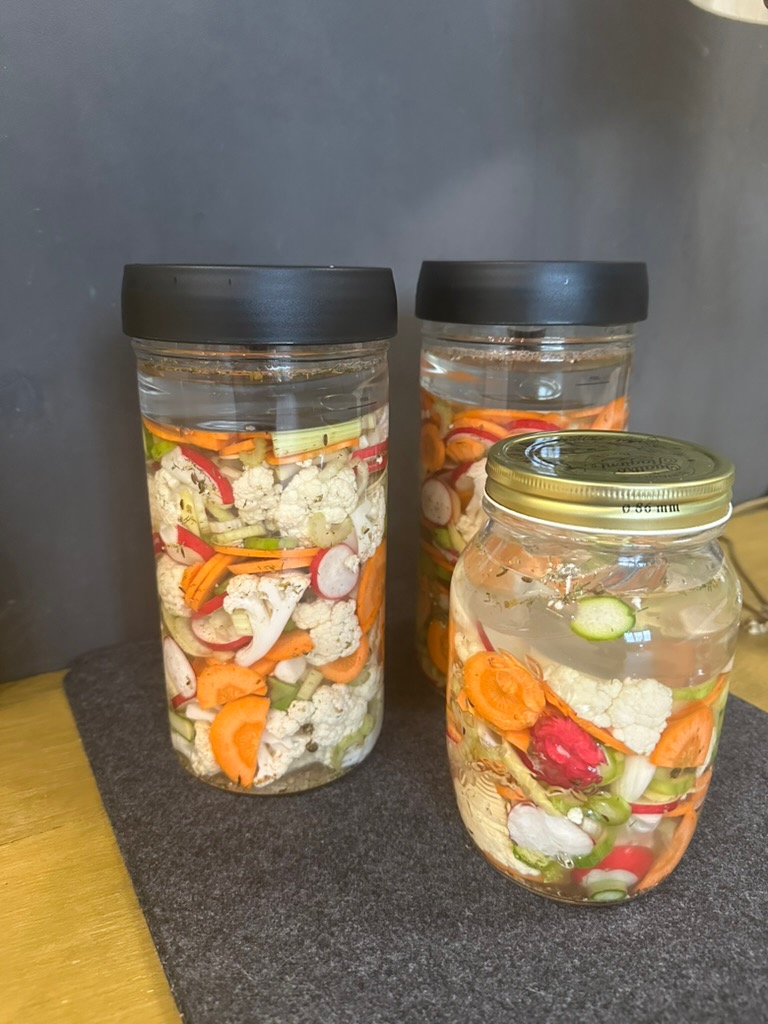
Small-batch fermentation is easier to keep up with when the jar earns its shelf space.
A chopped cabbage, a salty bowl of brine, and one clean jar can turn into sauerkraut on a quiet corner of the counter. The catch usually appears later: narrow shoulders trap bits of spice, odd lids do not fit airlocks, and bulky crocks sit empty between batches.
Plain glass jars can absolutely handle kimchi, pickles, hot sauce, and kraut, especially for casual batches. The most reusable options tend to have wide mouths, simple shapes, sturdy lids, and sizes that match real cooking habits. A jar that works with weights or fermentation lids, then goes back to storing beans, stock, or leftovers, feels less like specialty gear and more like a useful kitchen regular.
- 32 oz jars suit test batches, gifts, and fridge storage.
- 1.5–2 gallon jars are more comfortable for whole-cabbage kraut or larger pickle runs.
- Wide-mouth openings make packing vegetables and cleaning by hand noticeably easier.
Fast picks by use case




What makes a fermentation jar worth reusing
-
Wide mouths and straight sides
A jar that is easy to pack is also easier to empty, scrub, and reuse for beans, grains, soup, or sliced vegetables. Straight-sided jars tend to fit weights more cleanly and waste less shelf space than bulbous shapes.
Look forWide-mouth openings with simple, straight walls that accept common tools and storage lids.AvoidNarrow necks, deep shoulders, or decorative curves that trap food and make cleaning fussy. -
Glass that feels steady in regular rotation
Fermentation jars get lifted full, rinsed often, and moved between counter, fridge, and pantry. Thicker glass and a stable base can make repeat use feel less delicate, especially with larger jars.
Look forClear, sturdy glass with a flat base and enough heft to feel secure when filled.AvoidThin, tippy jars or oversized vessels that become awkward once packed with brine. -
Practical capacity after the first batch
A useful jar size is not only about kraut or pickles; it should still make sense for leftovers, brines, dry goods, or meal prep. Quart jars are flexible, while gallon-plus jars are better when big batches are common.
Look forSizes that match normal fridge and pantry habits, with headspace for active ferments.AvoidA capacity chosen only for one recipe, then too large or too small for everyday storage. -
Replaceable lids and accessory fit
Jars last longer when the lid system is not the weak point. Standard openings make it easier to swap storage caps, add weights, or compare lid options for fermentation jars without replacing the whole jar.
Look forStandard wide-mouth sizing, dishwasher-friendly shapes, and compatibility with weights or airlock lids.AvoidProprietary lids, odd threads, or parts that are hard to clean, replace, or store.
These jars were compared from a home-fermentation angle: how easily they handle a normal batch, then how useful they remain once the kraut, pickles, or starter is gone.
-
Day-to-day handling
Capacity mattered, but so did shape. A jar that fits a cabinet, accepts a hand or scrub brush, and pours without feeling awkward earned more confidence than sheer volume alone.
-
Beginner-friendly setup
Wide openings, included weights, airlock lids, and clear glass made a kit easier to start with, especially for common ferments like sauerkraut, cucumber pickles, carrots, and simple brines.
-
Reuse after fermenting
Preference went to jars that could move into pantry storage, dry goods, leftovers, fridge pickles, or another batch with minimal fuss and easy-to-replace lids or accessories.
No lab testing or durability stress testing was used; the focus is practical, hobbyist-level usability.
Folinstall 1.5-Gallon Square Jar Kit for bigger repeat batches
01
Best for large-batch fermenting with airlock control
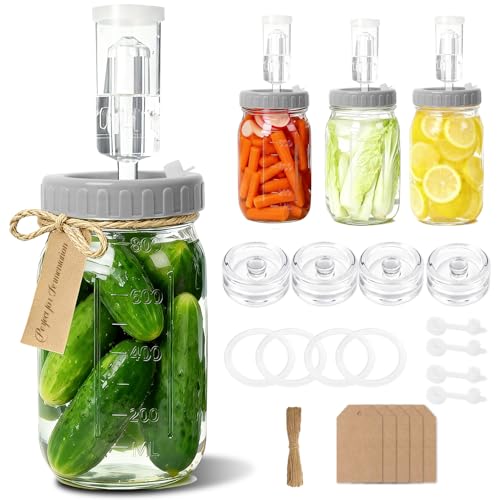
The Folinstall kit is built around roomy 1.5-gallon glass jars set up for airlock fermentation, with wide mouths, scale markings, airtight lids, and extra airlock valves included. It fits the home fermenter who has moved past single-quart experiments and wants a tidier vessel for larger runs of kimchi, pickles, kraut, or small mead-style batches.
Its appeal is less about novelty and more about keeping a recurring fermenting habit organized. Rather than spreading one project across several small jars, this gives a larger batch a dedicated container that can go back into rotation after cleaning.
- 1.5-gallon size works well for larger recurring batches
- Square shape can line up more neatly than round jars
- Wide mouth helps with packing vegetables and removing finished ferments
- Includes airlocks, airtight lids, and scale markings for a more complete setup
- Glass body keeps the jar broadly reusable between different food projects
- Less flexible for running several small test recipes at once
- Large glass jars can feel awkward in smaller sinks
- Square corners may take more attention during washing
- Needs more shelf or fridge clearance than standard quart jars
Quick take A practical all-around pick for fermenters who prefer one generous, orderly container over a cluster of smaller jars. The tradeoff is that its size and shape ask for more cleaning and storage space.
The Folinstall 1.5-gallon square jar kit is a strong fit for larger, repeat fermentation sessions where capacity and order matter more than recipe-by-recipe flexibility. The included airlocks and lids make it feel ready for regular use without needing many add-ons.
It is not as nimble as a set of smaller jars, especially for side-by-side experiments, and washing a big square jar can take a little patience. For a household that often makes one main batch at a time, though, it offers a nicely reusable setup.
Ball 32oz wide-mouth 12-pack for everyday reuse
Trusted brand jars for everyday fermenting
This Ball 12-pack is the practical bulk buy for households that want jars in steady rotation, not just one dedicated fermentation vessel. Each jar holds 32 ounces, a flexible size for small-batch pickles, sauerkraut trials, infused vinegar, dry pantry goods, soup leftovers, or a dressed-up food gift.
The wide-mouth shape is the main appeal. It leaves more room for packing vegetables, adding weights, and cleaning around the shoulder than narrow-mouth jars usually allow. It also makes the jars easier to repurpose after a ferment is finished, especially for chunky leftovers or scoopable pantry staples.
Because these are standard mason jars with lids and bands, they are more of a reusable base than a complete fermentation kit. Anyone comparing whether regular mason jars can work will usually find that they can, but airlock lids, glass weights, or silicone fermentation tops are often separate purchases. That tradeoff makes the set feel especially useful for people who want quantity and flexibility over a single specialized setup.
- Twelve jars make it easy to rotate batches, store extras, and share food gifts
- 32oz capacity suits small ferments without taking over the fridge or counter
- Wide-mouth opening helps with packing, filling, and cleaning
- Standard mason format works with many common replacement lids and accessories
- Fermentation weights or airlock lids are typically bought separately
- One-quart size may feel small for frequent large-batch fermenting
- Included metal lids can wear over time with salty or acidic foods
- Dishwasher-safe status is unclear from the listing, so hand-washing may be preferable
IceFun 4-Pack 32oz Kit for small parallel batches
All-in-one kit with weights and airlocks
This IceFun set sits between a plain case of Mason jars and a larger crock-style setup. It includes four quart-size jars plus fermenting lids, airlocks, silicone parts, and glass weights, so it suits someone who wants to try a few recipes without shopping for every add-on separately.
The 32oz size is approachable for sauerkraut, pickles, garlic, onions, or small test batches where committing a gallon jar feels like too much. Because the jars can move into storage duty after fermentation, the set has more everyday usefulness than a one-purpose gadget.
- Four jars make it easy to run several small ferments at once
- Included glass weights and airlocks reduce first-batch guesswork
- Quart capacity is practical for testing flavors without taking over the fridge
- Jars can still be reused for pantry or leftover storage
- Accessories may matter less later if they do not fit other wide-mouth jars or lids
- Four-jar quantity is modest for heavy canning or meal-prep use
- Plastic fermenting lids may not feel as long-lasting as standard metal storage lids
1.8L Wide-Mouth Fermentation Jars for a gentler step up
Dishwasher-safe jars ideal for beginners
This 2-pack of 1.8-liter glass fermentation jars sits in a comfortable middle zone: roomier than a quart jar, but not as bulky as a gallon crock or oversized vessel. That makes it a friendly choice for early batches of sauerkraut, kimchi, pickles, hot sauce, mead, or cider when a little extra headspace is welcome.
The pair format is the real charm. One jar can hold an active ferment while the second waits as a backup, stores a finished batch in the fridge, or makes room for a second recipe without committing much counter space. The clear glass also keeps the process visible, which can be reassuring while learning what bubbling, settling, and color changes look like.
- 1.8-liter size gives more working room than a quart without feeling oversized
- Wide mouth makes packing vegetables, adding weights, and cleaning easier
- Clear glass helps monitor bubbles, brine level, and ingredient changes
- Pack of 2 supports a backup jar, second recipe, or storage rotation
- Includes airlocks, so fewer starter pieces need to be sourced separately
- Not large enough for big harvest batches or heavy meal-prep quantities
- Only a small review pool, so long-term durability feedback is limited
- Airlock lids are useful for fermenting, but extra storage lids may still be handy
2-gallon jar pair for peak-season fermenting
High-capacity jars for bulk fermenting
This 2-pack of large glass fermentation jars is aimed at fermenters who already know which recipes disappear quickly. Each jar holds about 2 gallons, so the set makes more sense for repeat batches of dill pickles, sauerkraut, kimchi, garden peppers, or kombucha-style projects than for first attempts.
The square-ish shape, wide mouth, handled lid, airlock setup, and non-slip base give it a practical, workbench-ready feel. It is the kind of set that can turn a weekend harvest into one or two substantial ferments instead of several smaller jars scattered across the counter.
- Two 2-gallon jars can handle seasonal produce with fewer separate vessels.
- Wide mouths make packing cabbage, cucumbers, or kimchi mix less fiddly.
- Included airlock lids suit longer ferments without needing many extra parts.
- Reusable glass works well for bulk pantry storage between fermentation projects.
- The set is heavy, especially once filled with brine and vegetables.
- Tall jars may be awkward in shallow sinks, low cabinets, or crowded refrigerators.
- Large capacity is inefficient for testing a new recipe or tiny harvest.
- Cleaning and moving them takes more space and care than quart jars.
Keep fermentation jars ready for the next use
-
Wash soon after emptying
Rinsing brine, spices, and bits of vegetable before they dry makes cleanup easier and helps keep glass clear.
-
Separate lids, gaskets, and airlocks
Small parts trap moisture and aromas. Washing them apart gives salty residue fewer places to hide.
-
Deodorize lids gently
If plastic or silicone lids hold a garlic or kraut smell, a baking-soda soak can help. Let them air out fully before storing.
-
Keep spare storage lids nearby
A simple solid lid lets a fermentation jar move into fridge or pantry duty after the airlock and weight are washed and put away.
-
Dry everything completely
Store jars upside down until no moisture remains, then keep accessories clean and dry in a small bin or bag.
-
Check rims before each batch
Run a finger around the rim and look for chips or rough spots, since a damaged edge may seal poorly or feel sharp.
Wide-mouth jars earn their shelf space when they are not treated as single-purpose gear. After a batch is done, clean airlocks, weights, and gaskets can be stored together, while the jar itself can rotate into dried beans, leftovers, pickles, stock, or fridge storage.
For steady repeat batches, the Folinstall 1.5-Gallon Square Fermentation Jar Kit is a practical front-runner: roomy enough for cabbage or pickles, but still shaped for storage. The Ball 32oz Wide-Mouth Mason Jars 12-Pack makes the most sense when reuse matters most, since the jars can rotate into leftovers, dry goods, sauces, and gifting. For a first all-in-one setup, the 4-Pack 32oz Mason Jar Fermentation Kit keeps small experiments organized.
A simple buying rule holds up: match capacity to what the household will actually finish, favor wide-mouth glass, and choose jars with a second life between ferments.

Would’ve liked to see a pick for people doing hot sauce specifically. The square Folinstall jar looks nice for bigger batches, but peppers stain/odor everything and I’m wondering if the accessory parts hold smell more than the glass.
Also scale marks are underrated. Not essential, but super handy when you’re trying to keep ratios straight without dirtying another measuring cup.
The IceFun 4-pack seems like the sweet spot for someone who wants to test a few recipes at once. I like the idea of small parallel batches because half my “experiments” are just me discovering I don’t actually like fermented radishes 😅
Are the plastic lids in those kits usually dishwasher safe, or is hand washing better to keep the seals from getting weird?
I’d hand wash the plastic lids and silicone parts when possible. Many are technically dishwasher-safe on the top rack, but repeated heat cycles can warp lids or age seals faster.
The glass jars and glass weights are usually fine with a more aggressive wash, but drying the lids and airlock parts completely before storage matters a lot for reuse.
I’m surprised the 2-gallon jars are recommended at all for home kitchens. I bought one last summer for cucumber pickles and it was a beast to wash in a normal sink. Also heavy when full… like, “why did I do this to myself” heavy.
Maybe useful if you have a basement pantry or garden harvest, but for apartment people I’d rather have several 1 quart jars running side by side.
Curious why Weck jars didn’t make the list? I’ve been using the tulip ones for kraut and they clean up nicely, plus the glass lids are reusable forever. Is it just because the accessories are less standard than wide-mouth Mason stuff?
That’s exactly the main reason. Weck jars are great for reuse and they’re beautiful, but the article leaned toward jars with easier accessory compatibility, especially for beginners who may want to swap lids, weights, airlocks, or storage caps without hunting for specific parts.
Weck would be a good “premium reusable” mention, though, especially for people who already own the clips and gaskets.
Have you looked at Bormioli Rocco Fido jars? I see them at discount stores all the time and the clamp tops seem sturdy. Not sure if they count as fermentation jars, but they’re definitely reusable for storage afterwards.
I’ve used Fidos for fermented carrots and they worked okay, but I stopped using the wire bail lids during active fermentation. The seal can be a little too enthusiastic unless you’re watching pressure. Great storage jars though.
Good suggestion. Fido-style jars are excellent for pantry reuse and dry storage, but I’m cautious about recommending them as beginner fermentation jars unless the user understands pressure management or swaps to a fermentation-friendly lid.
For this list, I favored wide-mouth jars that accept common airlocks, silicone lids, and weights more easily.
The Ball 32oz 12-pack is probably the most realistic pick here imo. Not fancy, but I use the same jars for pickles, dry beans, leftovers, and random screws in the garage when they’re not fermenting 😂
I do wish the article had a budget section for people who don’t want to buy a full kit with airlocks right away. Like jars + cheap silicone lids + maybe glass weights later.
That’s fair. The Ball jars are basically the “infrastructure” pick: less exciting out of the box, but very reusable because the size and mouth are so common.
For a budget route, I’d usually suggest starting with wide-mouth quart jars, a few fermentation weights, and either burp lids manually or add silicone airlock lids later. The kits are convenient, but not required.