
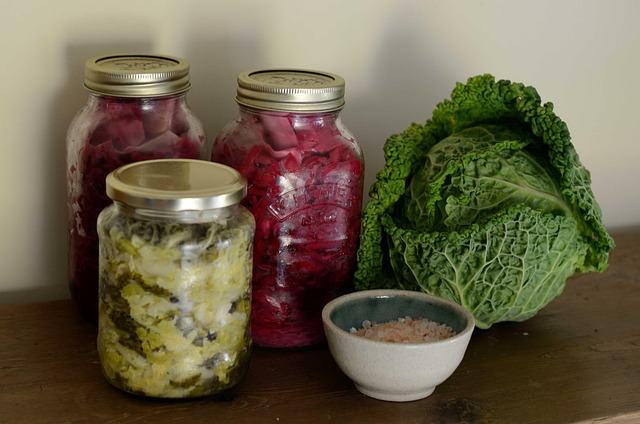
If every jar feels like a gamble, it’s usually not because you lack a knack for it.
I’ve had one jar stay crisp and lively, then the next turn too salty, too soft, or just a little suspicious. That kind of swing makes fermentation feel fussy fast.
What finally clicked for me: kraut problems often come from an inconsistent system, not shaky skills. Salting by feel, measuring with spoons, or bouncing between recipes that disagree means the cabbage never starts from the same place twice. You’re not failing the process. The process is asking you to guess with ingredients that naturally vary.
- A spoonful changes a lot between coarse kosher and fine salt.
- Cabbage water content shifts by season, size, and freshness.
Start with 2%
If I want one number that works reliably, I use 2% salt based on the weight of the cabbage. In practice, that means 20 grams of salt for every 1,000 grams of vegetables. It is not magic, but it is a very steady place to begin.
I trust that ratio because it usually lands in the sweet spot: salty enough to help the right fermentation microbes get established, but not so salty that the kraut becomes harsh or sluggish. It also scales cleanly, whether I am making one small jar or a big crock.
A few quick examples make it easier:
- 500 g cabbage → 10 g salt
- 900 g cabbage → 18 g salt
- 1.5 kg cabbage → 30 g salt
From there, I only make small adjustments. If I know I prefer a slightly softer, less salty kraut, I might edge down a little. If my kitchen is warm or I want a firmer texture, I might edge up a little.
Still, salt is only one part of a good batch. Temperature, keeping the cabbage submerged, and clean handling matter too. The reason 2% is so helpful is that it removes one big variable and gives the rest of the process a solid baseline.
Why the salt ratio works
Salt is doing several jobs at once. When I toss cabbage with salt and squeeze it a bit, the salt starts pulling water out of the leaves. That liquid becomes the brine, which matters because cabbage ferments more cleanly when it stays submerged instead of poking up into the air.
Salt also changes who gets an early advantage in the jar. It can slow many unwanted microbes and enzymes that make vegetables soften too fast, while lactic acid bacteria still have room to do their thing. As those bacteria feed on cabbage sugars, they produce acid, and that gradually makes the batch tangier and more stable.
I don’t think of salt as a magic shield. I think of it as setting the lane so the helpful fermentation microbes get a better head start.
- Too little salt can mean weaker brine, softer texture, and a messier start.
- Too much salt can slow fermentation noticeably and make the final kraut taste harsh or overly salty.
- A middle range gives you enough brine-building and microbial control without dragging the process.
That balance is the whole reason the number matters. The goal is not maximum salt; it’s enough salt to support the ferment without making it sluggish or unpleasant to eat.
What that percentage is really measuring
The under-a-minute way I figure out salt
-
Weigh the cabbage you’re actually fermenting
I put a bowl on the scale, tare it to zero, then add the shredded cabbage. I use the weight after trimming, coring, and slicing, because that is the amount going into the jar.
-
Find 1% by moving the decimal left one place
If the cabbage weighs 900 g, then 1% is 9 g. If it weighs 1,250 g, then 1% is 12.5 g.
-
Double that number for a 2% batch
This is the shortcut I use most: 9 g becomes 18 g, 12.5 g becomes 25 g. No fancy math needed.
-
Do a quick pattern check
These anchor numbers help me catch mistakes fast: 500 g = 10 g salt, 750 g = 15 g, 1,000 g = 20 g, 1,500 g = 30 g. If my answer looks way off that pattern, I recheck the scale or decimal.
-
Round sensibly and move on
If the number lands on a half gram, I usually round to the nearest gram unless my scale reads finer. For small home batches, that is often close enough.
If I’m using a kitchen scale that measures whole grams, I don’t worry about chasing tiny decimals.
The details that change the jar
Once I’m weighing the cabbage and salt, crystal size mostly stops being a problem. A tablespoon of fine salt and a tablespoon of coarse kosher salt can be very different weights, but 20 grams is still 20 grams. That’s why a scale usually matters more than whether the salt looks flaky, fine, or chunky.
A few variables still affect how the batch feels and tastes:
- Cabbage freshness: firm, heavy heads usually release brine faster and taste a bit sweeter.
- Older or drier cabbage: it may need more massaging and a little more time before enough liquid appears.
- Salt style: sea salt, kosher salt, and pickling salt can all work well when weighed.
- Additives: anti-caking agents or iodine may change flavor or make brine look slightly cloudy, but they’re more of a preference issue than a math issue.
For me, this is the reassuring part: I don’t need to chase a specific brand to get reliable sauerkraut. If the cabbage is in decent shape and the salt is weighed at the right percentage, the rest is mostly about texture, clarity, and small flavor differences — not whether the batch will behave at all.
When the ratio drifts, the jar changes fast
It may ferment faster, but it can also turn softer, leak more, and give surface yeast or off flavors more room to show up.
In my experience, dropping much below the usual range can make the cabbage feel less protected while it is still releasing brine. Speed is not the only thing changing.
Extra salt can slow fermentation so much that the cabbage lags before it acidifies well, and the result may stay harshly salty.
Salt helps, but it is only one part of the system. Too much can stall the balance you want from lactic acid bacteria.
Briefly exposed shreds are often a fixable maintenance issue, especially if the rest smells clean and the brine looks normal.
A weight, a smaller jar inside, or repacking can often restore submersion. Exposure is a problem to correct, not always a disaster.
No ratio can make fuzzy mold, pink or orange growth, or a rotten smell okay.
Those signs point past a simple brine adjustment. Salt supports fermentation, but it does not reverse clear spoilage.
The mid-batch questions I usually hear
My jar is dry on day one. Did I measure wrong?
Not necessarily. Some cabbage just releases brine slowly. I usually wait a bit, press it down again, and see whether the liquid level rises before assuming the ratio was off.
Can I add brine later?
Yes, if the issue is submersion rather than spoilage. A measured saltwater top-up can help cover the cabbage, but it will not fix a batch that already smells rotten or has colorful/fuzzy growth.
It tastes very salty after a few days. Is that normal?
Often, yes. Early kraut can taste sharper and saltier before the sourness rounds out. If the original ratio was high, fermentation may simply be moving more slowly.
White film on top: panic?
Not always. A thin matte white film can be kahm yeast, which is annoying but different from fuzzy mold. Texture, smell, and whether growth is hairy or vividly colored matter here.
Can salt percentage alone tell me the batch is safe?
No. It is a strong starting control, not a guarantee. Smell, appearance, submersion, cleanliness, and fermentation progress still matter.
If a jar is simply a little dry or not staying submerged, that is often a practical brine problem.
If it shows fuzzy mold, pink/orange growth, or a rotten smell, that moves into a different category. At that point, the original salt percentage is no longer the deciding factor.
My simple 2% routine
-
Weigh the cabbage
I use grams, then multiply the cabbage weight by 0.02 to get the salt.
-
Salt it evenly
I scatter the measured salt over the shreds so the batch starts out uniform.
-
Mix until it looks wet
After tossing and squeezing for a few minutes, I look for a good puddle of brine.
-
Pack the jar firmly
I press hard to remove air pockets and bring more liquid to the surface.
-
Keep the cabbage under brine
A leaf or weight can help hold stray bits down, which usually makes the jar calmer and cleaner.
-
Adjust slowly and take notes
If I want a change, I move in 0.25% to 0.5% steps and note the room temperature, cabbage, timing, and taste.
The number matters, but the repeatable routine is what makes the result easier to trust.
- The same salt ratio can still ferment differently when the room is warmer or cooler.
- Small, logged changes are easier to judge than starting over with a new method each batch.
For me, 2% becomes dependable when it turns into a habit instead of a one-time calculation. I weigh, salt, mix, pack, and keep everything submerged, then only tweak in small steps.
That steady process usually teaches me more than guessing ever did, and it makes the next jar easier to repeat.

This helped, but I’m still curious about mixing vegetables. If I add a decent amount of carrot or radish into the kraut, do you calculate 2% from total vegetable weight, or keep it based on cabbage only?
I’ve seen both approaches mentioned, and that seems like one of those “small detail, big jar difference” situations.
The “spoilage signs override ratio” line should probably be on a sticker for every fermenting jar. People get way too hung up on the number and ignore obvious fuzzy grossness.
Have you noticed any consistent difference in brine cloudiness between sea salt and kosher, assuming both are weighed correctly? Mine sometimes turns cloudy and I’m never sure if that’s normal fermentation or if I messed up something upstream.
I had a batch that tasted fine but stayed weirdly crunchy for a long time, almost like the salt slowed everything down too much.
If someone oversalts slightly, is the main effect usually slower acidification? Or can it also make the final flavor sort of flat? Mine wasn’t spoiled, just… stubborn.