
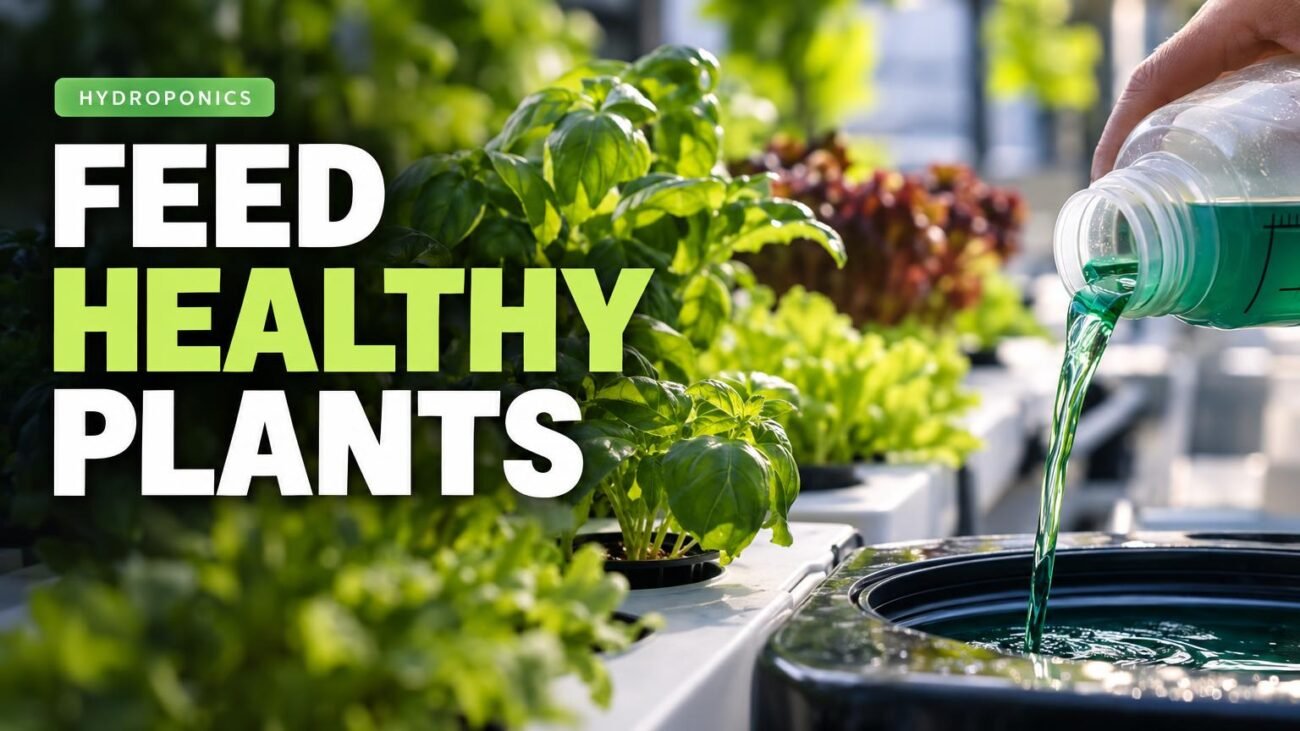
A steady feeding routine beats a perfect-looking recipe.
You fill a reservoir, pick up the nutrient bottle, and pause: is half a dose safer, or will it leave your lettuce hungry? I start with a complete hydroponic formula—one that supplies calcium, magnesium, and trace elements as well as the headline nutrients. Plain water cannot make up for what the bottle leaves out.
For young plants, I mix toward the low end of the label’s recommended range, then check the solution rather than guessing from the dose alone. EC tells me how concentrated it is; pH tells me whether roots can readily take up those nutrients. Neither number is a recipe, but together with new growth and leaf color, they show me when to adjust.
What the reservoir supplies
Plants make their own sugars using light, carbon dioxide, and water. The reservoir’s job is different: it supplies the mineral nutrients roots need to build new tissue and keep growing. I group them by how much the plant uses, not by how important they are.
- Primary nutrients — nitrogen (N), phosphorus (P), and potassium (K): Nitrogen supports leafy growth and proteins; phosphorus helps move energy through the plant; potassium regulates water use and activates enzymes.
- Secondary nutrients — calcium (Ca), magnesium (Mg), and sulfur (S): Calcium strengthens developing tissue, magnesium sits at the center of chlorophyll, and sulfur helps make amino acids.
- Micronutrients — iron, manganese, zinc, copper, boron, molybdenum, chlorine, and nickel: Plants need tiny amounts, but these elements help run enzymes, form healthy new growth, and process nitrogen.
For a first grow, I’d buy a complete hydroponic formula rather than mix individual mineral salts. Check that it includes micronutrients, not just N-P-K. A complete formula may come in two parts: keeping certain ingredients separate in concentrated bottles prevents them from forming insoluble solids before they reach the reservoir.
Why a full reservoir can still leave plants hungry
A complete nutrient mix can contain everything a plant needs, yet the plant may struggle to take it up. pH affects nutrient availability: when it drifts too far, certain minerals become harder for roots to absorb. That is why I check pH before adding more fertilizer in response to a suspected deficiency.
For many hydroponic crops, pH 5.5–6.5 is a useful starting neighborhood, not a rule for every reservoir. I follow the crop’s needs and the nutrient maker’s guidance, then measure after mixing the nutrients, because they can change the water’s pH. I add pH adjuster a little at a time, stir or circulate the solution, and retest rather than chasing an exact number with large corrections.
EC (electrical conductivity) tells me how readily the solution conducts electricity—a practical estimate of its dissolved salts. It does not tell me which nutrients are present or whether they are in the right proportions. A high EC could reflect excess fertilizer, salts already in the source water, or a buildup as plants drink water faster than they take up minerals.
I use EC to track the reservoir against my starting reading and the feeding guidance for my crop. If a meter displays ppm instead, I check its conversion scale: common “500” and “700” scales turn the same EC into different ppm numbers. EC is the more reliable number to compare across meters.
Pick nutrients you can mix consistently
-
A complete formula for your crop
I check that the label supplies primary, secondary, and trace nutrients, then look for feeding directions that fit my crop and growth stage. Lettuce and fruiting tomatoes may need different feeding strengths.
Look forA complete formula with usable crop and stage directions.AvoidA bottle that leaves essential nutrients to guesswork. -
A parts count you’ll use correctly
A one-part formula simplifies mixing; two-part formulas keep ingredients separate until diluted. I’d choose between them based on the routine, not assume the extra bottle grows better plants. The one-part and two-part trade-offs are worth checking before you buy.
Look forInstructions you can follow every refill.AvoidTreating more bottles as proof of quality. -
A form that fits your setup
Liquids are convenient to measure; powders often cost less per reservoir but need careful weighing and dissolving. I compare the practical differences between powders and liquids against how often I mix.
Look forA form you can measure accurately.AvoidSavings that depend on hurried, imprecise mixing. -
A repeatable mixing routine
I add nutrients to water in the label’s order, stirring between additions; I never combine concentrates directly. Once mixed, I check EC, then adjust pH.
Look forClear mixing order and dose ranges.AvoidAdding concentrates together or adjusting pH too early.
I start with the complete formula alone and watch growth alongside EC and pH. Supplements make troubleshooting harder when I haven’t learned what the base feed does.
Start with the water you have
The water I use is already part of the recipe. Tap water may contain calcium, magnesium, sodium, and other dissolved minerals, so its starting EC is not necessarily zero. Before adding nutrients, I measure and record that EC; then I measure again after mixing. This helps me see how much the feed changed the reading, though EC alone cannot tell me which minerals were already present.
Hard water deserves extra attention. Its calcium may contribute to the plant’s supply, but bicarbonates can push pH upward and make it harder to keep the reservoir in range. A high starting EC is not proof that the water contains a useful balance of nutrients. If pH keeps drifting up or I’m unsure what’s in the water, I check my water supplier’s report or consider testing it.
I also check whether the nutrient maker gives separate directions for tap water and reverse-osmosis (RO) water. RO water starts with very few minerals, but I add calcium and magnesium only when the formula or crop directions call for them. Label doses are my first mix, not a promised final EC or pH; I check both after mixing and adjust based on the plants’ response.
Mix the same way every time
-
Fill the reservoir with water
I add the intended volume of water before any nutrients and turn on the pump or stir it well. I note the starting EC if my water contains minerals.
-
Measure each part separately
I follow the label dose for the crop and growth stage, using separate measuring tools for each concentrate. That keeps one bottle from contaminating the other.
-
Add the first part and stir
I pour it into the water—not into another concentrate—and mix until it is evenly dispersed.
-
Add the second part and stir again
Only then do I add the next component. I repeat that add-and-mix sequence for any further components the formula requires.
-
Check EC, then pH
Once the solution is fully mixed, I compare EC with the feed target, accounting for any EC already in the water. I then measure pH and adjust it in small increments if needed, stirring and retesting between changes.
Calcium can react with phosphates or sulfates when undiluted concentrates meet, forming solids that plants cannot use. Dilution in the reservoir and thorough mixing between additions prevent that collision. If your bottles are labeled A and B, follow the exact two-part mixing sequence rather than combining them in a measuring cup.
Match feeding strength to growth
I treat the nutrient maker’s crop and growth-stage directions as my starting range, not a target to exceed. I begin near the low end, especially for plants newly moved into a system, and increase strength gradually as roots and foliage establish. Seedlings need particular care; my guide to their first feeds explains when to start and how dilute to mix.
For leafy crops, I usually keep a steady vegetative feed rather than change the recipe every week. Lettuce stays in leaf production, so pushing concentration for faster growth can do more harm than good. In a small reservoir, evaporation can raise EC without any added fertilizer. I top off with water and recheck EC before adding nutrients; my lettuce nutrient options for small grows cover formula choices in more detail.
Fruiting crops such as tomatoes and peppers change course as they flower and set fruit. Their demand may rise with plant size, while the balance they need can shift, so I follow stage-specific directions rather than simply making a vegetative mix stronger. I adjust in small steps and watch new growth, EC, and water use over several days. If a plant looks hungry while EC is already high, I check for an uptake problem before adding more fertilizer.
Read the reservoir before changing the feed
I check the water level, pH, and EC at roughly the same time each day, then look at new leaves and roots. Older leaves can keep showing damage after the cause is gone; new growth tells me more about whether my last adjustment helped. Healthy roots are usually firm and pale, though nutrient staining can darken them. Slime and a sour smell concern me more than color alone.
- Water level falls and EC rises: The plant is taking up proportionally more water than nutrients. I top up with plain water, let it circulate, then recheck EC and pH.
- Water level and EC both fall: Nutrients may be running low. I top up with a properly mixed, dilute feed, using my crop’s target EC as a guide—not a splash of concentrate straight into the reservoir.
- pH keeps drifting or readings stop making sense: I verify my meter first. If the solution is old, cloudy, or smells bad, I replace it rather than trying to correct it indefinitely; slimy roots also call for cleaning the system and checking aeration.
I change one thing at a time and note the result. That makes the next check-in far more useful than chasing every imperfect leaf.
For my first grow, I’d choose one complete nutrient formula and stick with it. I’d measure the EC of my source water before adding anything, then follow the label’s mixing order, stirring each part in separately. I’d start seedlings at the recommended lower strength and increase feed only as the crop grows. Once mixed, I’d check EC, then adjust pH.
At each reservoir check, I’d jot down the date, water level, EC, pH, and what the plants look like. If a reading drifts, I’d check the water level and top up as needed before changing the recipe. Then I’d adjust just one thing and watch the response. That small log makes it easier to learn what my crop and water need.

Does pH need checking every day, or is that overkill for a small reservoir? I can do it, but I’d rather not turn lettuce into a second job.