
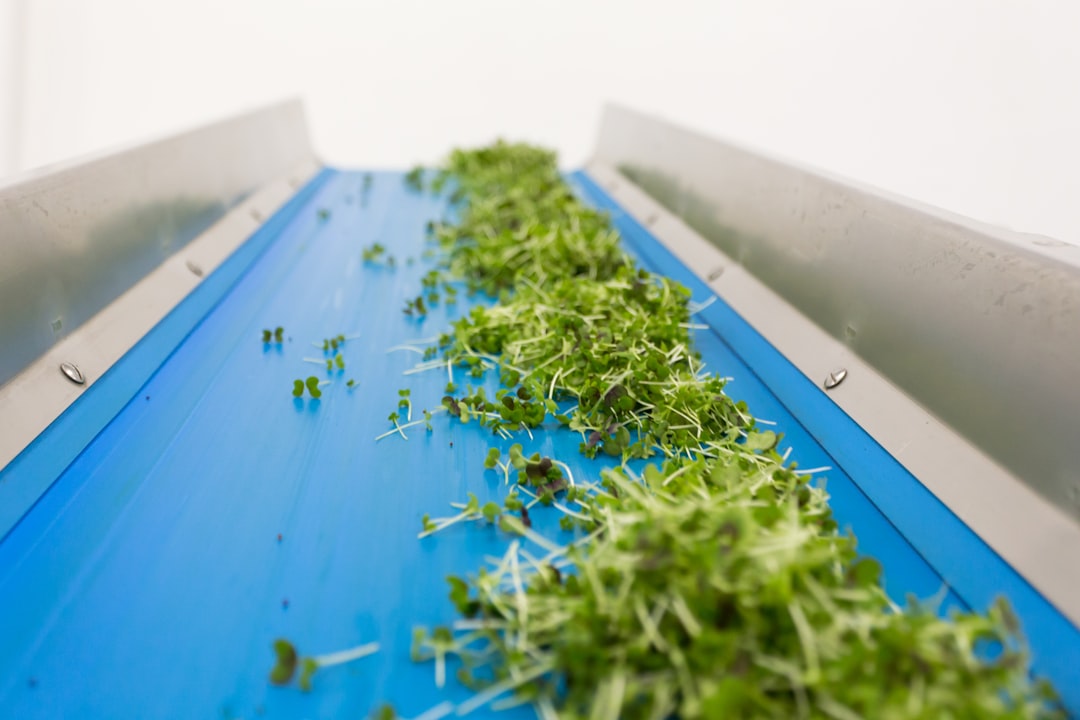
A fan rarely ruins a tray; a blast zone does.
The usual trouble spot is easy to recognize: damp tray corners, a little white fuzz, and that split-second worry that any fan will dry out tender greens. In my own grows, the problem is usually not having airflow but having airflow that is too strong, too close, or aimed at one tray for too long.
Microgreens often handle gentle, indirect movement much better than a hard stream. What tends to help is circulation that passes near the setup, breaks up humid pockets, and keeps the surface from staying clammy. CONTROL matters more than raw fan power. That is why fan angle, distance, and low-speed options matter just as much as whether I use a fan at all.
Match the fan to your setup



I’d look at mounting options and airflow style before fan size. A smaller fan clipped in the right spot often helps more than a larger fan parked too far away or blasting one tray edge.
In many setups, a gentle indirect breeze works better than a hard blast.
Light circulation breaks up damp, stagnant pockets without crusting the surface or pushing trays to dry unevenly.
Airflow helps, but watering, seed density, and room humidity often matter just as much.
A fan can move moist air away from the canopy, but it cannot fully cancel out soggy mats or crowded trays.
Too much direct air can dry edges faster than centers and stress tender growth.
I usually want a slight leaf flutter, not constant whipping.
What I look for on a real grow shelf
-
Low-speed control
I trust fans I can turn way down. A soft, steady stream is usually more useful than raw power.
Look forStarts gentle and stays even at its lowest setting.AvoidLowest setting still whips stems or dries tray edges fast. -
Aim or sweep
Air works better when it passes nearby, not straight into the canopy. Tilt, pivot, or a mild oscillation helps.
Look forEasy to angle above or beside trays for indirect movement.AvoidFixed airflow that points only straight at the crop. -
Stable placement
A good fan stays put when shelves vibrate or lights get bumped. Secure clips and planted bases matter more than fancy features.
Look forClip or base feels solid in the exact spot I need.AvoidSlips, droops, or needs constant readjustment. -
Noise and reach
I want enough throw to move humid pockets without turning the shelf into a wind tunnel. Lower noise makes it easier to leave running.
Look forReaches across the shelf while sounding tolerable nearby.AvoidNeeds high speed to reach trays, or gets annoyingly loud.
I compare fans by how controllable they feel in use, not by headline CFM. If I can dial one down and position it indirectly, it usually fits microgreens better.
I watch for slight leaf flutter and no visible soil disturbance at tray height.
I nudge the shelf and adjust the fan a few times to see whether it holds its angle.
I listen from a few feet away and note whether airflow reaches corners without blasting the nearest tray.
A stronger fan can still work well if its lowest setting is gentle enough.
Best-balanced tabletop pick for most hobby shelves
01
Powerful desktop airflow for steady circulation
The Honeywell TurboForce HT900 is the one I’d reach for first when I want steady airflow without overcomplicating a small grow shelf. Its compact tabletop shape is easy to park just off to the side, and the pivoting head makes it simple to send air past the trays instead of straight at them. For typical hobby setups, that balance is what makes it feel easy to live with.
- Compact body fits beside trays
- Low setting still moves useful air
- Pivoting head helps indirect placement
- Simple 3-speed controls
- Can be too strong up close
- Direct aim can dry tray edges
- Less forgiving in tiny shelves
For most home growers, this is the fan I’d call the safest all-around bet. It’s compact, easy to place off to one side, and strong enough on low to keep air moving across a shelf without needing a complicated setup. Just treat it like a circulator, not a leaf blower: angled across the area, it works nicely; aimed straight into trays, it can be a little much.
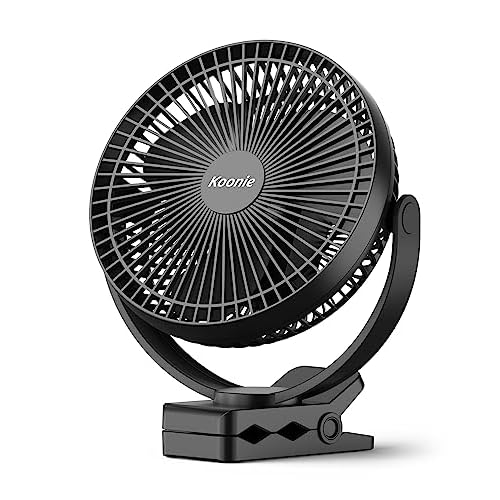
For awkward shelves and outlet-free spots: Koonie clip-on fan
Long‑runtime rechargeable clip fan for versatile use
On shelves where a normal desk fan has nowhere sensible to sit, I find the Koonie especially useful. The clamp can grab a rack post, wire shelf, or side rail, and the rechargeable battery lets me place airflow where the damp pocket actually forms instead of where a cord happens to reach.
That freedom matters on narrow racks, crowded upper tiers, or shelves tucked far from an outlet. I can aim it pretty precisely across tray edges or under a top shelf, which is often more helpful than simply using a stronger fan. If placement is your real headache, this style tends to fit the problem well.
- Clamp plus battery helps in hard-to-place setups
- Precise aiming works well on tight shelving
- Four speeds offer decent control for a clip fan
- Close placement can become too direct very quickly
- Needs charging if used off-cord regularly
- Clamp works best with a solid post or lip
DREO for room-wide background airflow
Strong whole-room airflow with quiet operation
If I were running several shelves in one room, this is the kind of fan I’d look at. The DREO makes more sense as a quiet air circulator sitting off to the side, nudging air across the space so damp corners don’t linger.
That matters because mold-prone trays often suffer from still, humid pockets, not just a lack of fan power. A broader, softer current can help even out the room without pointing a hard stream at one flat of microgreens.
For a tiny countertop grow, though, I’d call this a lot of fan. It’s better as background movement for a bigger setup than as a close-range tray fan parked inches away.
- Good for multiple shelves
- Quiet enough for background use
- Oscillation helps cover space
- Less need for close aiming
- Can be overkill for one tray
- Too strong up close
- Takes more table space
- Higher price than small fans
BESKAR: low-cost clip fan for a starter shelf
- Usually gentle enough for nearby trays
- Clamp and stand options make placement easy
- Low entry price for small setups
- Limited reach across wider shelves
- Top speed may be more than needed up close
- Corded USB power can limit placement
For a softer sweeping breeze: DR.PREPARE
Wide oscillation and large tilt range
If I’m nervous about a fan drying one corner of a tray while missing the rest, this DR.PREPARE makes more sense than a fixed-head model. Its 70° oscillation and broad tilt let airflow sweep across a shelf instead of sitting on one spot, so it feels easier to keep things gentle. The tradeoff is simpler: it uses more space than a tiny clip fan and gives me less pinpoint control.
- Sweeping airflow feels gentler
- Wide tilt helps coverage
- Three speeds for tuning
- Less precise than fixed aim
- Takes more shelf space
- No tiny clip footprint
How I dial in airflow without overdoing it
-
Start at the lowest speed
I begin with the gentlest setting, even on stronger circulators. It gives me a clean baseline before I blame the room or the tray.
-
Place the fan farther back than seems necessary
I usually start a few feet away, off to the side. Distance often softens the stream better than dropping straight to a weaker fan.
-
Aim across the shelf, not into the tray
I point airflow past the canopy or slightly above it so the room moves, not the media. If seeds or stems feel the blast directly, I know I’m too close.
-
Watch one full cycle before changing anything
I check for leaf flutter, dry tray edges, and whether wet corners stay glossy. If I notice trays starting to wobble in the airflow, that’s my cue to back off.
-
Tweak placement before power
A small angle change, a higher mount, or six more inches of distance usually helps more than jumping to a stronger setting. I treat fan speed as the last adjustment, not the first.
Too much air: leaves flicker constantly, edges dry first, lightweight seed hulls shift.
Too little air: damp corners linger, the surface stays still for hours, humidity seems trapped around the trays.
In my experience, tiny placement changes solve this more often than a more powerful fan does.
- Most shelves I’d start with the Honeywell HT900 for one or two trays on a typical shelf.
- No outlet The Koonie fits awkward racks, clamp setups, and spots without a handy outlet.
- Whole room The DREO makes more sense when I want room-wide circulation around several shelves.
- Recurring mold If mold persists, I’d check density, watering, and cleanup before adding more airflow.
If I were buying today, I’d keep it simple: Honeywell HT900 for most hobby shelves, Koonie for clamp-anywhere or outlet-free setups, and DREO when the whole room needs steadier background movement. Those three cover most real microgreens situations without pushing air too hard at the trays.
The BESKAR is the low-cost starting point, and the DR.PREPARE is the one I’d pick when a softer sweep feels safer than a fixed stream. If mold keeps showing up after airflow tweaks, the reasons it returns even after cleaning are often tray density, watering, or cleanup—not a signal to jump to a stronger fan.

No love for the little stroller fans from Amazon? Serious question lol. Some of those tripod-leg ones can wrap around shelves pretty well and they’re dirt cheap.
I’ve been using one pointed away from the trays and it’s… fine? Not amazing, but fine.
The Koonie being rechargeable is honestly the first thing that caught my eye. I’ve got one awkward wire rack with no outlet nearby, so that solves a real annoyance.
But also… battery fans always sound amazing until you realize you’re charging Yet Another Thing 😂
Still, nice to see a pick for weird setups instead of pretending every shelf is neatly next to a wall plug.
Why no Vornado 630 or 660? If the Honeywell HT900 is your balanced tabletop pick, I’m curious where the Vornado stuff fell short.
Is it just price, or are those models too strong for close shelf use?
A bit of both. Vornado models can be excellent circulators, but many are stronger, larger, and more expensive than what a typical microgreens hobby shelf needs.
The HT900 made more sense here because it can still move enough air from the side of a shelf, while staying in a more approachable size and price range for most readers.
I’m a little skeptical about the DREO suggestion for microgreens specifically. You do say it’s more for room-wide background airflow, which is fair, but I could see beginners buying it and then parking it 2 feet from trays and wondering why everything looks stressed.
Maybe that’s user error, but still.
Totally fair concern, and that’s why I tried to frame it as a room-air option rather than a tray-adjacent fan. The DREO makes more sense when the problem is stale room air and humid dead zones around a shelf, not when someone needs close, precise airflow right at seedlings.
If a grower wants something they can mount close and fine-tune carefully, the smaller clip-style options are usually safer.
That was my read too. I didn’t take it as “put this on your shelf,” more like “fix the room first if the whole space is damp.”
Surprised the AC Infinity clip fan didn’t make the list. I see that one recommended a lot in indoor growing groups.
Was it left out because it’s overkill for microgreens, or just not as good for the “gentle indirect airflow” thing you kept mentioning?
Mostly a fit issue. AC Infinity fans can work, but for many hobby microgreens shelves they’re stronger, bulkier, and pricier than needed if the goal is just preventing damp corners without drying trays.
For this roundup I leaned toward easier low-speed control, simple placement, and products that are less likely to accidentally blast young trays at close range.
Yeah that tracks. I use one in a tent and it’s great, but for a tiny rack it was honestly too much unless I aimed it way off to the side.
I appreciate that you said persistent mold isn’t always a “buy a bigger fan” problem. That gets glossed over way too much.
I kept increasing airflow and still had issues, turned out I was sowing too dense and reusing trays a little too casually 😬
The oscillating DR.PREPARE angle is interesting. I actually prefer a soft sweep because fixed airflow always makes me nervous, especially with sunnier windows and shallow trays.
Bigger footprint is the downside though. Shelf space disappears FAST.
Can you do a sub-$25 pick list sometime? That’s my only gripe here. The BESKAR is in there, yes, but I was hoping for more “absolute cheapest that still works” options.
Not everyone needs the nicest clamp or rechargeable battery pack. Some of us are just trying to stop fuzzy corners without creating a whole fan collection in the house.
That’s a fair ask. For a strict under-$25 lens, I’d probably center it on simple USB clip fans like the BESKAR type, with the main caveat being shorter reach and fewer refinement options at very low speeds.
I avoided stuffing the article with too many ultra-budget clones because quality and noise can vary a lot between nearly identical listings, but a dedicated budget-only roundup would make sense.
Glad you called out aim and distance more than raw power. People hear “prevent mold” and immediately go full wind tunnel.
I learned the hard way that a strong fan doesn’t fix overwatering. It just gives you overwatered trays that are now annoyed 😂
The BESKAR mention was helpful. I’m on a super small starter shelf and every review site keeps pushing room fans like everyone has a whole grow room lol.
For a 2-tray setup, is the cheap USB option basically enough if my room humidity is normal?