
A couple of trays can still make a whole corner feel like a greenhouse.
I know the setup can look small on paper—just a shelf, a light, a fan—yet the room still feels damp every morning. If lids, walls, or rack posts keep collecting moisture, that’s usually not a random weather blip. It’s a pattern, and that pattern is what tends to feed mold nerves.
That matters because hobby grows often live in closets, spare rooms, or tents where humidity has nowhere to go. You may not need a huge machine, but a modest dehumidifier can help when the air stays sticky week after week, even with decent airflow.
- Condensation keeps coming back after lights-out
- The space smells earthy or stale between harvests
- One fan helps circulation, but the heaviness stays
My fast match list
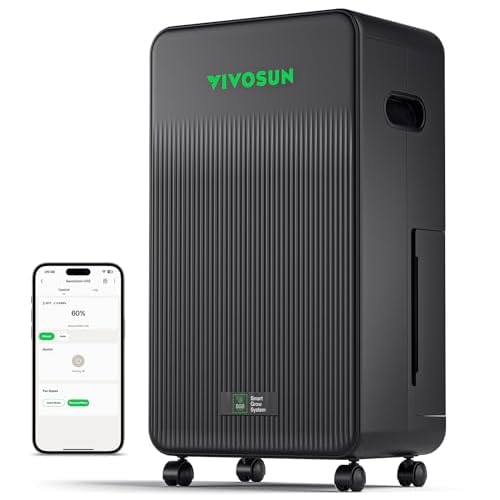



I’d probably begin with VIVOSUN AeroDrain D12. It looks like the easiest middle-ground option for typical microgreens humidity battles.
One exception: if outside-the-tent placement matters most, MARS HYDRO or SPIDER FARMER may be the cleaner fit.
Is it really a humidity problem?
Before I blame humidity, I try to figure out whether the whole space is damp or whether one part of the setup is causing trouble. If tent walls, nearby shelves, or windows stay damp even between waterings, that usually points to a real moisture load.
If the issue sticks to one tray, one crop, or one corner, I look at setup mistakes first:
- Overwatering: heavy trays, soggy mats, standing water, and roots that stay wet long after lights-on.
- Weak airflow: stale smell, condensation under domes, and fuzzy growth in still corners.
- Crowding: leaves pressed together, center trays drying slowly, and trouble showing up where air can’t move.
- High room humidity: multiple trays affected at once, hygrometer readings staying high day and night, and condensation returning fast after wipe-down.
When the signs overlap, I usually check watering habits, fan placement, and tray spacing before I size up a dehumidifier.
Put one hygrometer at canopy level and another just outside the rack or tent. A big difference often means the setup needs work, not just drier air.
The differences that actually show up during a microgreens grow
-
Footprint and fit
For a shelf, rack, or tent corner, size matters as much as raw capacity. A compact unit can be enough when humidity rises only around trays, while a whole-room machine makes more sense when the entire space stays muggy.
Look forA shape that fits your tent or room without blocking airflow or tray accessSkipA bulky unit that forces awkward placement or steals grow space -
Drainage and controls
I find drain hoses, humidistat settings, and auto restart matter more than flashy specs. They cut down on emptying tanks and help keep humidity steadier between sowing, blackout, and dense-canopy stages.
Look forContinuous drainage, clear setpoints, and simple humidity controlSkipTiny tanks and vague controls that need constant babysitting -
Noise and heat
Small grow areas can feel every fan sound and every degree of extra warmth. Compressor models often pull more water, but they can add more noise and heat than desiccant-style minis.
Look forManageable noise and heat for the room where you actually workSkipA unit that dries well but overheats a small tent -
Tent vs. room use
A tent-focused model works best when moisture is concentrated and you can duct or drain easily. If your walls, floor, and windows also stay damp, capacity starts to matter much more than smart features alone.
Look forCapacity matched to the moisture load, not just tray countSkipAssuming any mini unit can handle a persistently humid room
I compared these by how they fit real hobby setups: a small tent, a rack in a spare room, and a damp whole-room grow space. I gave extra weight to the features that change daily use, not just the headline pint rating.
-
When a small unit is enough
Usually when moisture stays close to the trays, airflow is decent, and the room itself is mostly dry.
-
When capacity matters
Usually when condensation shows up beyond the grow area, tanks fill fast, or humidity rebounds quickly after lights-out.
Smart tent-focused control: VIVOSUN AeroDrain D12
01
High-capacity smart dehumidifier for precision control
This is the model I’d look at when a simple mini unit starts feeling underpowered, but a full-room dehumidifier still seems like overkill. It’s built around grow-tent use, with a sensor probe and app-based control that make it easier to manage humidity where the trays actually are.
For enclosed microgreens setups, that purpose-built approach feels more practical than adapting a general household machine. It makes the most sense for growers who want steadier conditions and don’t mind paying extra for grow-specific convenience.
| Price | ~$240 |
| Removal | 12L/day |
| Tank | 2L |
| Coverage | 215 sq ft |
| Control | App + probe |
| Mode | Automatic |
| Size | 10.83 x 18.98 x 7.28 in |
- Made for grow tents, not just general room use
- Sensor probe allows more targeted humidity readings
- App control and automation are handy for repeat grows
- 12L/day is a meaningful step up from tiny units
- Price is high for a hobby setup
- Purpose-built design may be unnecessary for casual growers
- 2L tank still means drainage planning matters
Quick take I think this lands in a very practical middle zone: more precise and grow-friendly than small generic units, without jumping straight to a bulky whole-room machine. The catch is simple—it only feels worth it if you’ll actually use the automation and tent-specific design.
If I wanted one unit that covers most enclosed microgreens setups without getting overly industrial, this is the one I’d shortlist first. The main appeal is control: targeted sensing, automatic operation, and capacity that feels appropriate for a serious tent.
I still wouldn’t call it a casual buy. If your trays only occasionally nudge humidity upward, a simpler option can help for less.
Fine-grain drying with 10 adjustable levels
Tiny-space pick: The AC Infinity HYDRONE 5 makes the most sense when I’m working with a shelf, cabinet, or very small tent where every inch counts. Its 10 drying levels give it a more precise, dial-it-in feel than most mini units.
For a hobby setup around 2–3 plants, that control can be genuinely useful. I just wouldn’t treat it like a room fixer: with a 2 L/day rating, once the surrounding room is already muggy, a unit this small can run out of headroom pretty quickly.
- Very compact footprint
- 10 drying levels
- Good for 2–3 plants
- Plant-focused controls
- Only 2 L/day
- Limited room reach
- No app control
Duct-ready design keeps heat out of tents
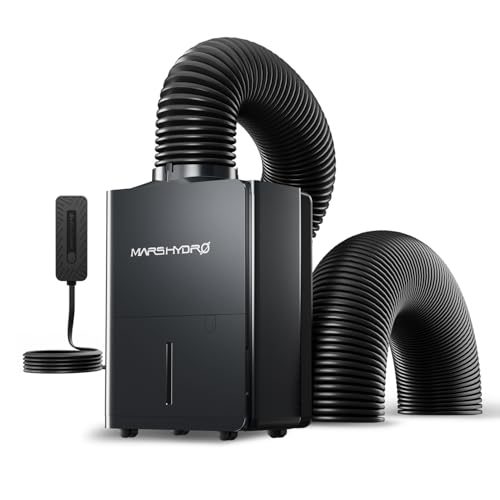
If my real headache is placement rather than just RH numbers, this MARS HYDRO is an interesting step up from the tiny shelf units. It uses a compressor design and includes ducting, so it can sit outside a tent and still handle damp air inside. I’d look at it for awkward corners, crowded racks, or multi-tent spaces where giving a dehumidifier its own spot matters almost as much as raw moisture removal.
- Duct helps awkward layouts
- Compressor output suits stubborn humidity
- Drain hose included
- Useful digital readout
- Bulky for small grows
- Heavier to reposition
- Likely noisier than minis
- Can be overkill fast
A room-scale step up for bigger rack setups
Designed to sit outside grow tents
Once I’m running several trays at a time, tiny dehumidifiers start feeling more like cleanup tools than real control. This Spider Farmer unit makes more sense when the whole space is holding moisture, not just one shelf or tent. The drain hose and continuous mode fit longer grow cycles, and the sensor probe adds a more deliberate, set-it-and-monitor feel. I’d look at it for fuller racks, shared grow rooms, or damp basements where mini units keep losing ground.
- More stable with heavier moisture loads
- Continuous drainage supports longer runs
- Outside-tent ducting can limit added heat
- Much bulkier than mini units
- Compressor operation is more noticeable
- Higher upfront cost than small models
- Cordless and tiny
- Simple recharge cycle
- Low upfront cost
- Very limited moisture capacity
- Needs periodic unplugged recharging
- Not a room solution
What I’d pick by grow setup
Even a well-matched unit can struggle if the grow is adding water faster than the room can shed it.
A few basics still move the needle:
steady airflow across and under trays avoiding overwatering or standing runoff enough spacing that damp air doesn’t stall between shelvesThat’s why placement and moisture load matter as much as the model itself.
Mini unit or room unit?
If humidity spikes only in a dome, tray corner, or tent, a compact grow model usually fits. If the whole room stays muggy, move up to a compressor unit with continuous drainage.
Can a mini fix a damp room?
Usually not. Eva-Dry and the AC Infinity help with light, localized moisture; stubborn room dampness is more SPIDER FARMER or MARS HYDRO territory.
Will a dehumidifier stop every mold problem?
It can smooth humidity swings, but it will not undo overwatering, crowded trays, or weak airflow. In my grows, it helps most when the basics are already pretty solid.
Where I’d land
Here’s my quick rule: localized humidity spikes point me to AC Infinity HYDRONE 5 for tiny shelves or domes, or VIVOSUN AeroDrain D12 when I want tent-friendly control and cleaner automation. If the whole room feels damp, I would skip minis and look at SPIDER FARMER 38P for bigger rack areas with continuous drainage, or MARS HYDRO 38P if outside-tent ducting is the easier fit.
I’d treat Eva-Dry as a light helper, not a real answer for a wet grow room. Even the stronger picks work more like stabilizers than miracles; they help most when watering, spacing, and airflow are already pretty solid.

I liked the part where you separated actual room humidity from overwatering/crowding. A lot of microgreens articles act like every droopy tray means “buy a gadget” lol.
That said, why no Frigidaire or hOmeLabs mention for the room-scale category? I know they’re not grow-branded, but for bigger rack setups those are usually what people already look at first.
Appreciated the “fast match list.” I always skip to that part first 😅
For a 2-shelf setup in a spare bedroom, would you still lean AC Infinity HYDRONE 5 over just bumping airflow and cracking the door? I’m trying not to spend tent-money on a room that’s only *sometimes* damp.
The phrase “humidity keeps winning” is painfully accurate 😂
One question: why include the VIVOSUN D12 as a premium tent pick but not list a cheaper manual-control tent unit alongside it? Even if it’s worse, I think some readers want the compromise option spelled out more clearly.
I liked your “where I’d land” section because it finally said the obvious: a dehumidifier won’t fix sloppy watering.
But I’m wondering why the HYDRONE 5 got the tiny-grow nod instead of something like a generic $40 Amazon unit. Is it mainly the 10 levels, or did it actually handle condensation/stale air better in a real microgreens setup?
Also, for people using one rack in a closet, would you personally buy the HYDRONE 5 first, or skip straight to a drainage-ready room unit if the room itself already runs humid?
For the tiny-grow slot, the HYDRONE 5 stood out more on controllability and fit than raw moisture removal. In a small closet or cabinet, those adjustment steps can help you avoid swinging from too damp to too dry, and it’s less awkward to place near a compact setup.
If the *room* is already humid most of the day, though, I would not expect a small unit to be a magic fix. In that case I’d usually skip ahead to a drainage-ready room unit, because the ambient load keeps overwhelming the mini category.
This matches my experience. I bought the small-unit-first option and basically just purchased myself an expensive lesson 😅
Once the whole room is damp, the tiny machines just look busy.
The Eva-Dry inclusion makes sense for closets, but I’m surprised it made the list over a basic small Peltier unit with a drain hose. Is the cordless/recharge thing really that useful in practice, or was it more of a budget filler pick?
Why wasn’t there a “best used/secondhand” angle here? Genuinely asking.
For hobby microgreens, I’ve had better luck cleaning up a basic used compressor dehumidifier than buying two tiny new mini units that barely dent the ambient humidity. Budget shoppers might need that option called out more directly.
I was thinking the same thing. Facebook Marketplace is full of them, and half the time people sell after one basement season.
Only downside is noise… some older ones sound like a truck starting up.
Good writeup overall, but I’m skeptical about the probe-driven control hype. Is the SPIDER FARMER 38P really worth mentioning over a plain room dehumidifier plus separate hygrometer?
Feels like some of these grow-specific models charge extra because they’re black and have an app.
Fair pushback. For room use, a standard compressor unit plus a decent hygrometer can absolutely be the better value.
I included the probe-based models because they solve a specific grow-space problem: sensing conditions where the crop actually is, not where the machine happens to sit. In tents and tightly packed rack areas, that can change how often the unit cycles and how stable the humidity stays. If someone doesn’t need that placement flexibility, a regular room dehumidifier is often the more economical move.
I’m on a pretty hard budget and was hoping for more under-$50 options.
Not complaining, just saying the jump from the Eva-Dry mini to the “real capacity” units feels huge. If someone has recurring condensation on a window near one small rack, is there anything in the middle, or is that basically the point where the cheap stuff stops mattering?
This was actually helpful because you talked about heat output. So many reviews ignore that part, and then people wonder why their enclosed grow area suddenly feels weird.
I am curious though: did the MARS HYDRO 38P and SPIDER FARMER 38P really perform differently enough to split them out? On paper they look kinda like cousins wearing different hats.
Maybe I missed it, but why no mention of the Waykar-style 34 pint units people use in laundry rooms?
I get that the article is microgreens-focused, and footprint/noise matter way more around racks and tents. Still, once you start talking about “stubborn room humidity,” the non-grow-branded compressor models seem like obvious comparison points.