
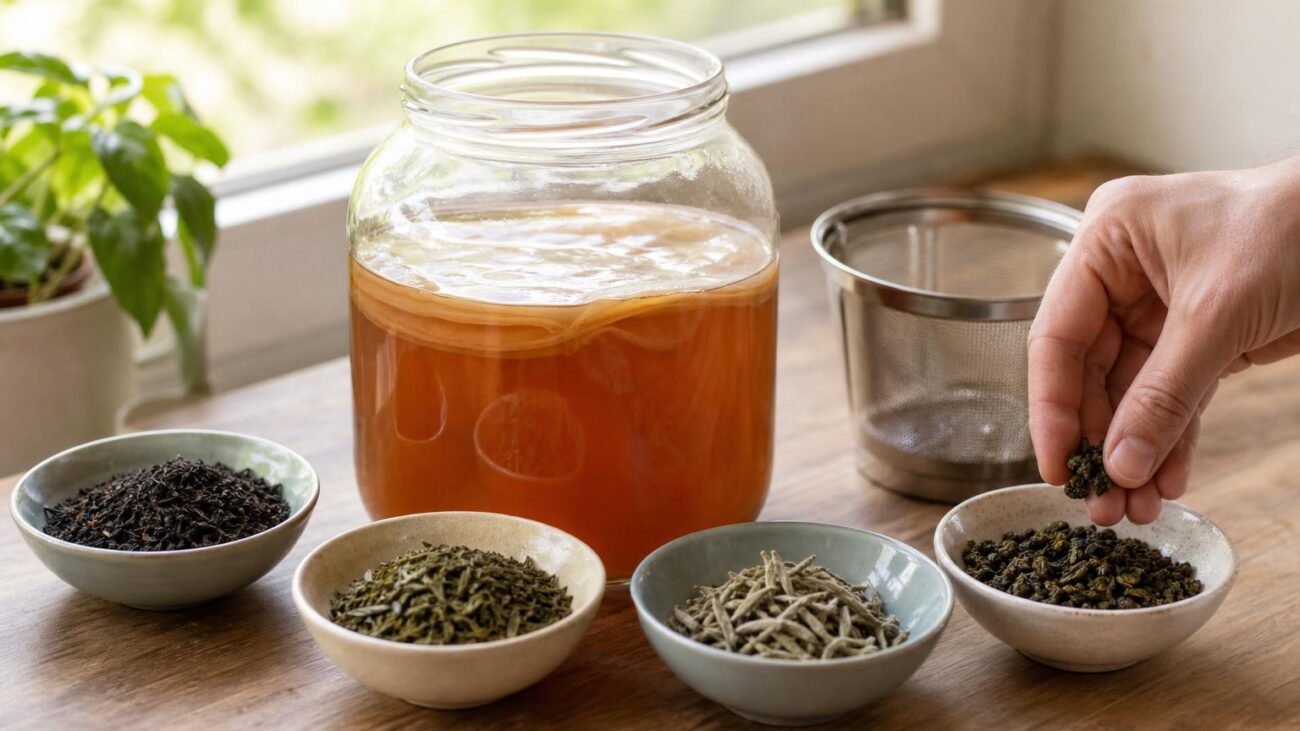
When a once-happy jar suddenly acts moody, the tea is often the quiet culprit.
One batch goes flat, the next turns sharply sour, and the SCOBY that looked lively last week seems to drag its feet. That kind of swing can feel personal, but it often starts with something simpler: the tea base.
Tea is one of the easiest variables to check first. Some cultures stay steadier on plain black tea, while others slow down when blends, heavy flavorings, or very light green teas enter the rotation. Before assuming the culture is ruined, it can help to treat tea choice as a reset button rather than a failure.


What a picky culture looks like
A SCOBY that seems fussy often shows it in repeatable ways. One batch moves along on plain black tea, then stalls on a jasmine blend. Another looks fine until frequent tea swaps leave the brew slower to acidify, slower to form a new pellicle, or a bit flat in aroma.
Common signs include:
- steady results with unflavored black tea but uneven batches with blends
- a sluggish start after teas with oils, spices, or fruit pieces
- weaker fermentation after changing teas every batch
These clues help, but they are not proof. Temperature, sugar level, and starter strength can create similar ups and downs.
If a culture seems selective, comparing small batches with the same sugar and room temperature can make tea-related differences easier to notice.
Plain tea usually gives a fussy culture fewer surprises
-
True tea first
Leaves from Camellia sinensis bring the tannins and nutrients kombucha cultures commonly handle with fewer complaints.
Look forBlack, green, oolong, white, or pu-erh teaAvoidHerbal infusions standing in for tea -
Keep the ingredient list short
Extra fruit, spice, and flavoring can change how a batch behaves and make tea sensitivity harder to judge.
Look forOne-ingredient tea, or a very plain blendAvoid“Natural flavors,” oils, fruit pieces, or sweet add-ins -
Choose steady sourcing
Reliable packing and turnover matter because a picky SCOBY often responds better to repeatable inputs than fancy branding.
Look forClear origin or packer details and fresh-smelling teaAvoidDusty, stale, or mystery bulk tea -
Skip scented teas for testing
Perfumed teas can leave behind extra variables when a culture is already touchy.
Look forUnscented loose leaf or plain tea bagsAvoidStrongly scented styles when troubleshooting
A culture may seem tea-sensitive when the bigger issue is the balance between leaf strength and sweetness. It often helps to match tea with the sugar approach before deciding a tea itself is the problem.
Branding matters less than whether the bag holds plain tea leaves.
A culture uses compounds from Camellia sinensis, not promises like “detox,” “cleanse,” or “superfood.”
They can be trickier than simple black or green tea.
Petals, herbs, and especially added oils may smell pleasant but can give the culture less usable food.
Those traits can be nice, but blend makeup usually matters more.
A plain organic tea often works well; an exotic blend heavy on fruit pieces or flavoring may not.
Fancy labels can distract from the practical question: how much real tea is in the blend, and what else came with it?
Good first retry
When a brew starts acting temperamental, plain black tea is often the simplest baseline. A breakfast-style black tea gives the culture a familiar mix of tea solids and caffeine, without extra floral notes, oils, or spice blends that can muddy the picture.
This Lipton organic option is a practical example: 360 individually wrapped bags, plain caffeinated black tea, and a profile meant for everyday hot or iced tea rather than novelty flavoring. For kombucha, that kind of consistency can matter more than prestige. A large box also makes repeat test batches easier, since each round starts from roughly the same tea.
For a touchy SCOBY, the easiest labels to recognize are often:
Breakfast tea Orange pekoe Ceylon AssamThese names are not identical in flavor, but they are often sold as straight black tea without added oils or botanicals. That makes them useful when trying to rule out tea-related variables.
The label to pause on is anything scented or blended, such as Earl Grey, chai, vanilla, or fruit-flavored black tea. Those can brew fine for drinking, yet they add extra moving parts when a batch is already unstable.
Lighter teas without a hard switch
Green tea and oolong often give kombucha a cleaner, softer profile than full black tea. Still, a touchy culture may treat a total swap as a bigger change than the flavor suggests, especially if recent batches have already been inconsistent.
A gradual move usually causes fewer surprises:
- Black-green blends can be the easiest first step, often starting around a mostly black base with some green tea added.
- Oolong often lands in a comfortable middle: lighter than black tea, but sometimes a bit less abrupt than going fully green.
- Keeping plain black tea in rotation every few batches can make it easier to compare fermentation speed, aroma, and pellicle growth.
The goal is not chasing a dramatic flavor jump all at once. It is more about finding the lightest tea profile that still keeps the brew acting familiar and steady.
If a batch on lighter tea seems slower or less decisive, that does not always mean the tea is wrong. It can simply mean the culture prefers smaller changes.
A simple green tea test option
This 100-count box is a practical way to trial plain green tea without extra flavoring in the label. The bags are individually wrapped, which can help with freshness and consistency from batch to batch. Twinings describes it as smooth and refreshing; for kombucha, it may make the most sense as part of a black-green blend first, rather than as an immediate full replacement.
Save white tea for later
When experiments can wait
White tea, pu-erh, and decaf true tea can make interesting kombucha, but they usually fit better after a culture is behaving steadily on plain black or green tea. White tea can ferment more gently, pu-erh brings a strong earthy character, and decaf can feel less predictable from brand to brand.
If a SCOBY seems unusually delicate even with plain tea, tea may not be the whole story. It can help to check the rest of the setup:
- Starter liquid may be weak, old, or low in acidity.
- Temperature may be cooler than expected.
- Sugar ratio or batch size may be drifting between brews.
- The culture itself may have started off stressed.
A culture that struggles with every simple tea often benefits more from a solid reset than from increasingly unusual tea experiments.
Some of these can still be enjoyable later — just not as the main tea during a fragile stretch.
A touchy SCOBY often handles experiments better after a few calm batches on plain black tea. If a favorite tea is hard to give up, it may work more gently in a small blend rather than a full swap. Many brewers also save florals, herbs, and spice-heavy profiles for second fermentation, where they add flavor without asking the culture to live on them.
The smart pick is usually the plain, repeatable one
-
Short ingredient line
A dependable base tea usually keeps the label boring. One tea named plainly is often easier to troubleshoot than a blend with extras.
Look forBlack tea or green tea listed simply, with no added flavorsAvoidNatural flavors, bergamot, chai spices, vanilla, fruit, flowers, or oils -
Bags for routine batches
Standard tea bags can be less romantic than loose leaf, but they make scoop size and brew strength easier to repeat from batch to batch.
Look forBasic bags with a clear count and tea typeAvoidLoose blends that vary lot to lot or need careful measuring -
Easy to replace
A tea that can be bought again without much hunting helps when a culture reacts badly and comparison batches are needed.
Look forCommon grocery-store styles sold year-roundAvoidSeasonal tins, single-estate lots, or frequent formula changes -
Freshness over prestige
Fancy origin stories matter less here than clean storage and consistent packing. Individually wrapped bags can help if the box sits open for a while.
Look forSealed packaging and straightforward storageAvoidAged-open boxes and heavily perfumed tea aisles
A simple plan for the next batch
-
Begin with one plain black tea
A basic breakfast-style or straight black tea makes a clean reference point. Running it for a couple of batches can show whether the culture settles when the tea itself stops changing.
-
Keep the rest of the setup identical
Using the same sugar, starter amount, vessel, temperature range, and brew time removes extra noise. That makes the next result easier to read.
-
Test only one change at a time
After the baseline looks normal, one small swap—such as a partial green tea blend or a different black tea—can be tried by itself. If several things change together, the cause stays murky.
-
Compare balance, not just speed
A fast batch is not always a better batch. Aroma, tartness, sweetness, and how quickly the tea turns thin often say more than a single pH or day count.
-
Look beyond tea if the pattern stays off
When acidity keeps racing or the brew stays dull, tea may be only part of the story. At that point, broader troubleshooting for overly acidic kombucha can help narrow down starter strength, temperature, or timing.
How long should the reset tea be used?
Two or three similar batches is often enough to spot a pattern. One batch can still be an outlier.
Is a full tea switch necessary during a reset?
Usually not. The goal is a stable baseline, not a dramatic change. A familiar plain black tea is often the easiest comparison.
What counts as one change?
One tea variable at a time, such as leaf type, brand, or blend ratio. Changing tea and temperature together makes results harder to interpret.
If the batch is still sharp, does that mean the tea failed?
Not necessarily. Very tart kombucha can also come from warm conditions, a long ferment, or strong starter dominating the balance.
- Plain black tea is useful because it makes comparisons clearer.
- Stable conditions reveal whether tea is the real trigger.
- Persistent imbalance can point to process issues as much as tea choice.
A fussy culture often responds better to a calm, repeatable setup than to more experimentation. Starting plain, holding conditions steady, and changing one variable at a time gives each batch a fair read.
If the flavor still runs too sharp or never quite levels out, the tea may not be the only moving part.

Maybe dumb question, but what counts as a “breakfast-style” black tea? Is English Breakfast okay even if it’s a blend, or do you mean something more basic like generic store-brand black tea bags?
I wish more kombucha articles said this plainly tbh. So many make it sound like if I’m not using some rare fancy tea, I’m doing it wrong.
My SCOBY apparently has the temperament of a Victorian child and gets dramatic over everything lol. I switched back to plain black tea and things got way more normal.
Same here. The expensive floral stuff sounded fun, but plain black was the only thing that gave me consistent results batch to batch.
Question about decaf: is it a total no, or just not ideal as the main base? I have a family member who keeps buying decaf tea by accident, and I’m trying to figure out whether it’s usable in a partial blend or if I should just stop experimenting before I create another sad jar on the counter.
For the gradual swap idea, what percentage would you start with for a black/green blend? Like 75/25 for a batch or two, then 50/50?
I’m pretty new to this and trying not to do the classic beginner thing where I change five variables and then pretend I learned something 😂
When you say “plain black tea,” do you mean literally just black tea in the ingredients and nothing else? I was looking at a box that said black tea but then had “natural bergamot flavor” in small print.
I’m guessing that counts as scented and not a good reset tea, right?
Yes — for a reset batch, I’d skip that one. If bergamot or any other flavoring is listed, it adds another variable, and the whole point of a reset is to make the base as plain and repeatable as possible.
A good starter choice is a short ingredient list that just says black tea, with no oils, flavors, botanicals, or perfume-like additions.
If a batch stays really sharp/vinegary even with plain black tea, would you look at starter ratio first or temperature first? The article mentions tea might not be the real issue, and that part honestly felt very relevant.
I keep blaming ingredients, but my kitchen temp swings a lot between day and night, so now I’m wondering if I’ve been chasing the wrong problem.
This helped, but I’m still confused about green tea fermenting more slowly. Does that mean I should just leave it longer, or does a picky SCOBY actually get weaker on green tea over a few batches?
I tried a green batch once and it got tart eventually, but the pellicle looked kinda thin so I wasn’t sure if I was slowly wrecking things 😅