
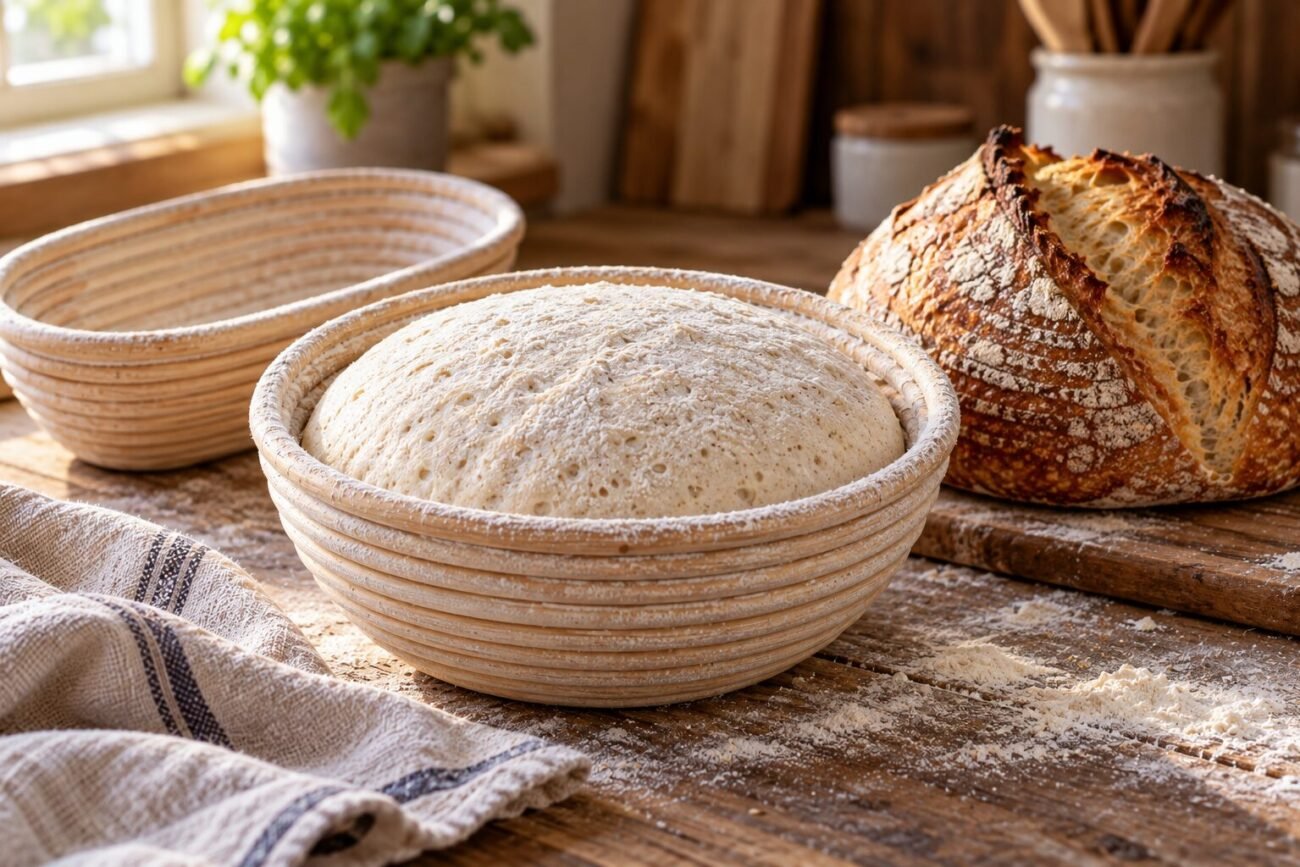
A flatter loaf often starts with the basket, not the starter.
You shape a dough that looked taut on the counter, then watch it relax into a squat loaf in the oven. That’s maddening—especially when bannetons are labeled 8, 9, or 10 inches with almost no clue what dough they actually fit.
In my experience, this is usually a fit problem, not a random sourdough failure. Too roomy, and the dough can spread; too tight, and it can overfill and lose support at the rim. Match the basket to the dough’s weight and shape, and loaf height gets much easier to predict.
- 9-inch rounds often suit about 1.5 lb of dough.
- A 1kg basket usually gives larger boules more room.


I treat it as side support, not a magic mold. A slightly snug banneton can help dough proof upward and keep a cleaner curve, but the loaf still needs decent strength before it goes in.
What banneton size labels actually tell me
500 g, 750 g, 1 kg
These numbers usually mean dough capacity, not one fixed basket size. I’ve seen two “1 kg” bannetons with noticeably different widths and depths.
Inside diameter
This is the measurement I trust most for side support. A slightly narrower basket can help a boule proof upward instead of outward.
Depth
Depth is easy to miss in listings, but it changes how contained the dough feels. Deeper baskets can be more forgiving with wetter doughs.
Round vs oval
The shape name only describes the footprint. I still compare weight rating and actual measurements before assuming how much dough it can hold.
I start with the dough weight I plan to proof, then I check the basket’s inside dimensions and depth. If a listing only says small, medium, or large, I treat that as missing information rather than a real size guide.
Quick dough-weight ranges
If I’m chasing a taller loaf, I usually get better support from the smallest basket the dough can fill comfortably. A slightly snug fit helps the dough hold its sides instead of relaxing outward.
| Basket class | Round banneton | Oval equivalent |
|---|---|---|
| Small | 8 in: 500–750 g | 9 in: 500–800 g |
| Medium | 9 in: 750–1,000 g | 10 in: 750–1,000 g |
| Large | 10–11 in: 1,000–1,300 g | 11–12 in: 1,000–1,400 g |
These ranges are starting points, not strict rules. Wet doughs often need a bit more support, while very strong doughs can sometimes sit happily in a slightly roomier basket.
If your dough only covers the bottom and leaves lots of bare sidewall, going down one size can help it proof taller.
After shaping, the dough can look comfortably settled, not lost in the basket and not bulging far above the rim. That middle ground often gives the nicest upward support.
| Size | 9 in x 3.5 in |
| Capacity | ~1.5 lb dough |
| Shape | Round |
| Quantity | Set of 2 |
| Material | Natural Indonesian rattan |
| Price | ~$25 |
At-a-glance fit
- Good fit: dough sits about halfway up the wall.
- Underfilled: low, flat puck with lots of empty basket.
- Overfilled: rounded above the rim, with little room left.
Seeing basket fit
That Sourdough Gal compares common banneton sizes, which can make these visual cues much easier to spot.
Round or oval changes the look
Round baskets often look taller because the dough stacks upward into a tighter footprint. With an oval, the same dough can sit lower while stretching lengthwise, so the loaf may seem less lofty even when the total volume is very similar.
That shape choice also changes the baked silhouette:
- Round bannetons usually give me a higher-domed boule
- Oval bannetons tend to make a longer batard with a gentler side rise
Sometimes the real question is not height, but what happens after proofing. If I want to match my banneton to my Dutch oven size, an oval basket can fit an oval roaster or a narrower baking setup more naturally. A round basket often works more neatly in standard round Dutch ovens, with a bit more even side clearance.
So when a loaf looks “short,” I usually think about shape, vessel, and scoring together—not basket size alone.
| Shape | Oval batard |
| Length | 10 in |
| Pack | 2 baskets |
| Material | Bamboo + sugarcane pulp |
| Storage | Stackable |
| Surface | Smooth, absorbent |
| Support | Ridged walls |
After size, I pay closest attention to support and release
-
Wall depth and firmness
Once the diameter is right, deeper, sturdier walls usually help the dough hold its shape during proofing. I’ve found shallow baskets are less forgiving with wetter doughs.
Look forWalls that reach high enough to cradle the dough without letting it slump wide.AvoidLow, flexible sides that let the loaf relax outward too easily. -
Material feel
Natural rattan gives good airflow and a bit of grip, which can help a shaped loaf keep its surface tension. Pulp baskets can release cleanly too, but they often support the dough a little differently.
Look forA material that feels dry, rigid, and evenly finished.AvoidRough splinters, soft spots, or a flimsy basket body. -
Sticking and release
For real-world results, dependable release matters almost as much as fit. A loaf that sticks can deflate right when it should be heading into the oven.
Look forSmooth inner surfaces and consistent flour coverage, with no snaggy seams.AvoidPronounced rough patches or loose liners that wrinkle under the dough. -
Cleanup and drying
A basket that dries quickly is easier to keep in good shape between bakes. Trapped moisture can make flour paste into the grooves and make future sticking more likely.
Look forOpen weave or surfaces that brush out easily and air-dry fast.AvoidBaskets that stay damp or hold packed flour in hard-to-clean creases.
If I had to prioritize after size, I’d put reliable side support first and easy release second. A simple basket that holds its shape and lets the dough turn out cleanly can give more consistent results than a prettier one that sticks.
| Size | 9 in. |
| Shape | Round |
| Capacity | 1kg |
| Material | Pressed wood pulp |
| Build | Thick-walled |
| Origin | Made in Germany |
| Price | ~$40 |
| Color | Cream white |
Is the basket really the problem?
My loaf spreads after turning out. Is the basket too big?
Maybe—but mainly if the dough sat low with lots of empty wall space. If it filled the basket fairly well, loose shaping or a full proof is often the bigger factor.
When does size look clearly wrong?
If a boule barely reaches halfway up the sides, it usually isn’t getting much support. If it domes high over the rim, it may push outward instead of upward.
What if it looked tall in the basket but baked flatter?
That makes me check fermentation and surface tension first. If the dough was already slack, revisit how you shape after bulk fermentation ends.
Should I replace the banneton right away?
Usually not. I’d only swap baskets after seeing the same fit problem over a few bakes with similar dough weights.
A banneton can support structure, but it can’t create it. Good fit helps, while dough strength, shaping, and proof timing still decide a lot of the final height.
How I narrow it down
-
Start with dough weight
I match the basket to my usual dough, not a one-off bake. For many home loaves, that often lands around a 9-inch round or a similar oval.
-
Pick the loaf shape
Boules usually look taller in round bannetons, while batards stretch lengthwise in ovals. I choose the shape that matches the loaf I actually like to bake.
-
Match the baking vessel
If my Dutch oven is snug and round, a boule tends to fit more cleanly. A longer cooker or baking steel usually gives an oval loaf more room.
-
Decide how much support you want
For more sidewall help, I lean a little snugger. If I want a more relaxed, wider country look, I leave a bit more space.
This simple approach fits normal home kitchens better than bakery-style sizing rules.
If I bake the same loaf most weeks, I buy for that dough weight first and treat everything else as occasional.
Closer fit and decent wall depth can help softer or higher-hydration doughs keep a taller shape while proofing.
Slightly stiffer doughs often tolerate a roomier basket if I do not mind a broader profile.
- Safe default For many home boules, I’d start with a 9-inch round for about 1.5 lb of dough.
- Height bias If two sizes both seem workable, I lean slightly smaller when I want a taller loaf.
- Tie-break rule Choose the basket that lets the dough sit roughly halfway up the walls at proof.
- Basket role A banneton helps hold shape; it can’t fix weak shaping or overproofing.
Buy for fit, not just label
If I wanted one easy default, I’d buy a 9-inch round for typical 1.5-pound sourdough and size up only when my usual dough is clearly larger. When height is the goal, the snugger of two reasonable fits usually gives me more side support.
That said, the basket is a helper, not a shortcut. Good shaping, dough strength, and proofing still do most of the work.

This helped, but I’m still a little confused about the 9-inch thing. If a basket is labeled 9-inch and also says 1kg or 1.5 lb depending on the listing, which number should I trust more?
I’ve been burned by weird product descriptions before, so now I’m side-eyeing every banneton listing on the internet 😅
Okay but real question: how much of the “my loaf spread everywhere” problem is actually the basket, and how much is just me being bad at shaping? 😂
I bought a so-called non-stick basket for wetter dough and it did release better, but the loaf still baked flatter than I wanted. So I’m guessing the article’s point about dough strength/proof level is the annoying truth lol.