
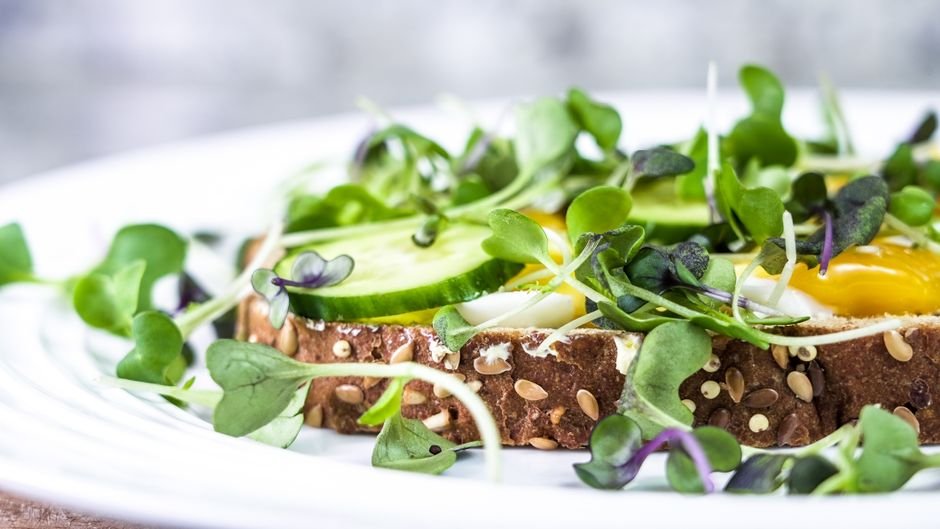
A garnish looks nice; a small handful usually feels like real use.
When I’m looking at a tray, the real question isn’t maximum—it’s what I’ll actually eat again tomorrow. A decorative pinch feels more like a finish, while a small handful is where microgreens start acting like an ingredient in eggs, sandwiches, or salad.
For many people, that works out to about 1/4 to 1/2 cup, loose-packed, depending on the variety. It’s not an official rule, just a realistic daily amount that can feel noticeable without emptying a whole tray in two meals.
- Loose-packed, that’s often roughly 10–20 g.
- Pea and sunflower greens fill a cup faster than broccoli or radish.
What amount actually feels worthwhile?
So how many microgreens per day is actually useful?
For everyday eating, I’d call a small handful enough to be worth adding—about 1/4 to 1/2 cup loose-packed, or roughly 10 to 20 g. There isn’t any official daily requirement, so “useful” is really the amount that fits into meals often enough to become normal.
Is more always better?
Not really. A big mound can overwhelm the meal, while a modest portion slips easily into eggs, sandwiches, soups, or grain bowls. If you’re wondering whether microgreens make sense as an everyday food, regular use matters more than chasing a bigger serving.
Can I split that amount across meals?
Absolutely. A little at lunch and a little at dinner still gets you to about the same place. I find this easier than trying to build one extra-large serving into the day.
What if I only eat them a few times a week?
That can still be worthwhile. There’s no pass-or-fail cutoff here; a repeatable habit usually does more for real-life eating than buying a tray with ambitious plans and forgetting it in the fridge.
If measuring grams makes this feel fussy, I’d keep it simple:
Small garnish: a pinch or two Useful everyday amount: a loose small handful Easy upper end for a meal: around half a cupThat’s enough structure to be practical without turning lunch into math.
What does a useful amount look like in real meals?
What does that amount look like at breakfast?
For me, 1/4 cup is a light tuft on eggs, avocado toast, or a breakfast sandwich. Closer to 1/2 cup looks more like a small side pile next to the main food.
How does it fit into lunch or dinner?
In a salad bowl, it can be one loose handful mixed in with the greens. On soup, tacos, grain bowls, or pasta, I think of it as a generous topper rather than a full base.
Why is volume easier than weighing?
Most people are not pulling out a scale for a sandwich. A loose 1/4- to 1/2-cup habit is easier to repeat, and in day-to-day meals that consistency matters more than hitting one exact gram number.
What if my handful looks bigger or smaller than yours?
That is normal. Pea shoots, sunflower, and radish can look bulky fast, while finer greens compress more, so a fluffy handful and a packed handful may not weigh the same even if they fill a similar space.
Why the amount varies so much
There isn’t one number that feels “right” in every kitchen. I’ve found that the same small handful can feel generous in one meal and barely noticeable in another. A peppery radish mix hits harder than mild sunflower, so flavor strength changes how much actually feels worth adding.
Texture matters too. Tender broccoli or kale microgreens can disappear nicely into eggs or rice, while chunkier pea shoots act more like a mini side salad. If they’re the finishing touch, I use less; if they’re doing some of the heavy lifting on the plate, I use more.
A few practical things usually decide the amount:
- Flavor intensity: spicy or bitter greens often go farther.
- Meal role: garnish, mix-in, or base changes the useful portion.
- Freshness: older greens lose snap and impact, so the same volume may feel less satisfying.
- Cost and availability: pricier trays tend to get used more sparingly.
- Personal taste: some people want a background note; others want a clear green bite.
For me, the useful amount is the one that I can taste, enjoy, and repeat without feeling like I’m wasting greens or money.
A few myths worth clearing up
For most people, a small handful already does the job.
Once the flavor gets sharp or the pile turns awkward to eat, the habit usually gets harder to keep.
They make more sense as a boost to meals, not a swap for full-size veg.
Regular vegetables still bring bulk, crunch, water, and fiber that help a meal feel complete.
A steady routine tends to be more useful than catch-up portions.
Smaller amounts are easier to fit into breakfast, lunch, or dinner without waste or palate fatigue.
If I get curious about how microgreens compare nutritionally with regular vegetables, I still come back to the same practical point: they can lift a meal, but they do not need to carry the whole vegetable job. A repeatable sprinkle or handful is usually more realistic than forcing a giant portion.
Fresh trays or powder?
Are fresh microgreens and powders the same thing?
I treat them as different shortcuts, not true swaps. Fresh greens bring texture and a real food portion, while powders are more of a pantry backup when fresh greens or powder fits daily life better.
Where is a sensible place to start?
I’d begin with about 1/4 cup loose-packed fresh microgreens. That feels easy to tuck into a meal without turning it into a project.
Where do people often land after that?
A lot of everyday use seems to settle around 1/4 to 1/2 cup fresh per day. Stronger varieties can feel worthwhile in smaller amounts.
How do I tell if my amount is actually useful?
My simple filter is: can I eat it most days, enjoy it, and add it without friction? If yes, that amount is probably more useful than a bigger portion I keep skipping.
A simple rule
Rule of thumb: start small, then keep the smallest amount you’ll happily use most days. Fresh microgreens act more like food on the plate; powders act more like convenience in the cupboard.

Okay but real question: does anyone else find 1/4 cup looks totally different depending on how fluffy the greens are? A loose handful of sunflower shoots is not the same universe as a loose handful of tiny broccoli microgreens.
Not a complaint at you, more at food measurements in general lol. Cups for leafy things always feel slightly chaotic.
I get the idea that 1/4–1/2 cup is the useful range, but does that change much depending on the type? Radish microgreens hit way harder than broccoli in my experience, so half a cup of radish sounds… intense lol.
Also curious whether people rotate varieties or just stick to one tray until it’s gone.
Yes, the type matters quite a bit in practice. Stronger varieties like radish, mustard, or arugula often feel more “useful” in smaller amounts simply because they’re more noticeable and easier to integrate in tiny portions, while milder greens may be easier to use by the bigger handful.
A lot of people naturally rotate based on flavor and what fits the meal, not because they need a perfect schedule. If one tray is punchy, a smaller daily amount is still a perfectly reasonable habit.