
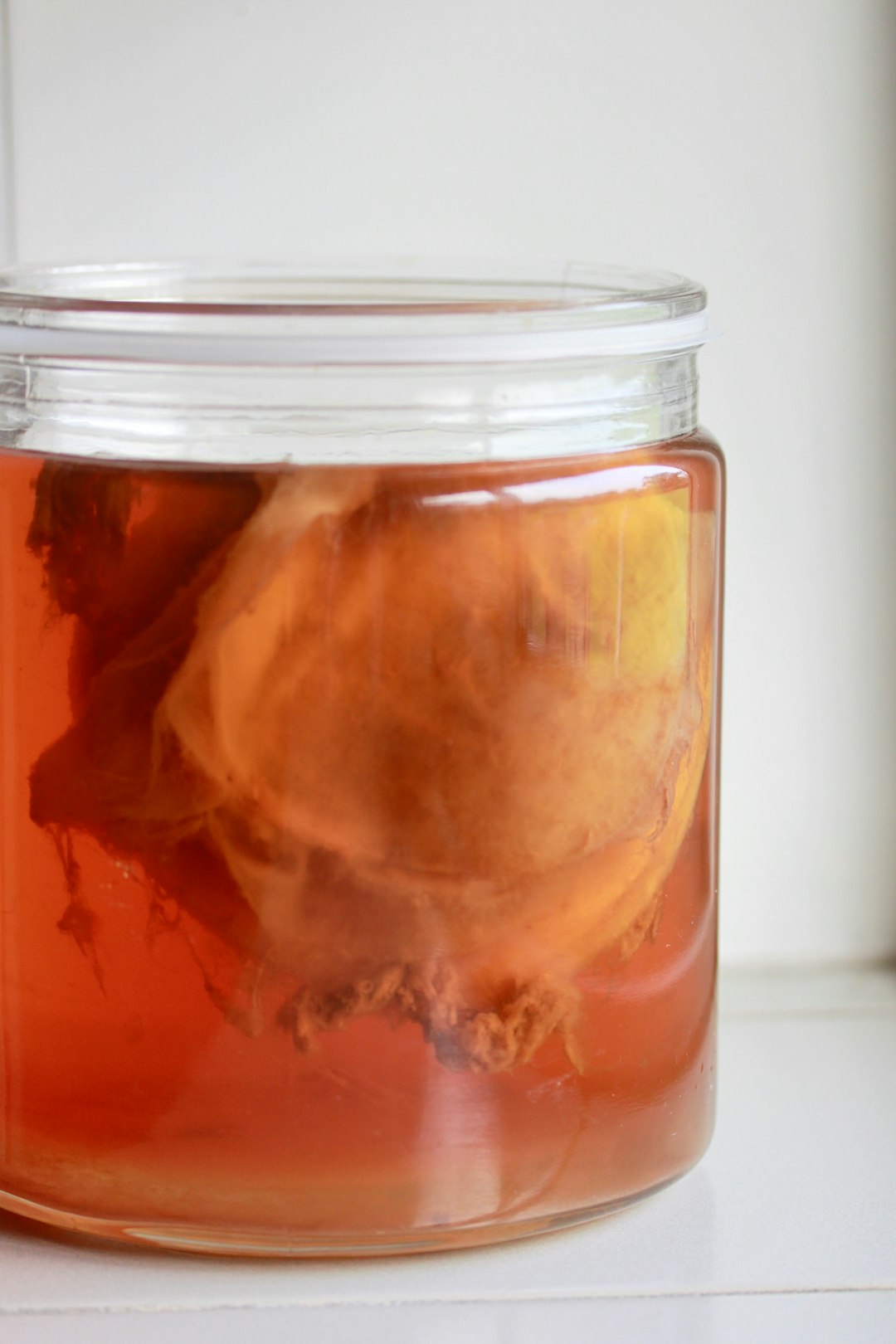
A lumpy, spotty jar can look disastrous long before it’s actually dangerous.
You lift the cloth, see a pale blob, stringy brown bits, maybe a slick-looking film, and suddenly the whole jar feels suspicious. I’ve had that exact jolt. Homemade kombucha can look surprisingly ugly even when everything is moving along normally.
That’s what makes this stage so unnerving: healthy growth often looks weird first. New SCOBY layers can be translucent, wrinkled, bubbly, uneven, or dotted with yeast strands that resemble wet paper or little sea creatures. The real job isn’t deciding whether it looks pretty; it’s figuring out whether it looks merely odd or genuinely risky.
- Brown strings and clumps are often yeast, not automatically a problem.
- A new SCOBY layer may form patchy, thin, or off-center before it evens out.
- SCOBY
Strictly speaking, this is the culture living in the brew: bacteria and yeast working in the sweet tea. A lot of home brewers, me included, also use the word for the rubbery layer on top.
- Pellicle
This is the floating cellulose layer that forms on the surface during fermentation. It can be pale, tan, wrinkled, lopsided, or full of bubbles and still be normal.
- Texture check
When I’m deciding whether a batch looks safe, texture tells me more than color. Smooth, shiny, and wet usually points to normal growth.
- Mold warning sign
Mold tends to look dry, fuzzy, or powdery, often with distinct circular spots. That surface texture is a bigger concern than whether the patch is white, blue, green, or black.
Look at the surface, not the shade
What normal can look like
A pale top film is often flat and slick. Brown strings or sediment below are usually active yeast. Both can look strange at first.
Spot real mold
PepperAmmy shows normal false alarms beside true mold.
Odd shapes can still be normal
Odd shapes can still be normal
A pellicle can look surprisingly awkward while the brew is doing fine. I’ve had old layers sink, new ones grow lopsided, and plenty that looked wrinkled or pocked before evening out.
Common harmless quirks include:
- Sinking pellicles: an older layer can drop while a new film forms on top.
- Wrinkles and folds: the surface often ripples as it thickens.
- Bubbles or blisters: trapped carbonation can push up little domes.
- Small holes or thin spots: these can come from popped bubbles or uneven early growth.
- Off-center growth: jar shape, airflow, or a slightly tilted cover can affect where the film starts.
What I pay attention to most is the newest top surface, not the culture’s overall shape. If that fresh layer looks wet, smooth, and creamy to tan, the odd geometry alone usually doesn’t concern me. Mold typically shows itself on the top as dry, fuzzy patches—not just because the pellicle is crooked, sunken, or full of bubbles.
When I call it mold
If the growth is dry, fuzzy, matte, powdery, or clearly raised above the liquid, I stop there and call it mold. This is where texture beats color. Green, blue, white, or black can all be suspicious, but even a pale patch can be bad news if it looks like it could dust off the surface.
- Dry or dusty instead of slick
- Fuzzy or velvety instead of smooth
- Raised patches sitting on top of the brew
A healthy new pellicle usually looks wet, glossy, or jelly-like. Mold tends to look chalky and separate, forming little islands above the surface film. If you’ve seen mold on other fermented foods, the same dry, above-the-surface look is a bad sign here too.
If I see those signs, I dump the whole batch rather than trying to rescue the liquid or save part of the SCOBY. Once contamination is visible, I treat the brew, pellicle, and starter as one compromised batch. It feels wasteful, but for me a fresh restart is usually simpler than guessing.
If the patch is above the surface and looks dry, fuzzy, or powdery, I make the conservative call and let the batch go. Trying to peel off the spot and keep the rest usually isn’t worth it.
The murky middle cases
It smells off, but I don’t see fuzz. Does smell mean mold?
Not by itself. In my batches, kombucha can swing from tart and yeasty to a little sulfur-y, and that still isn’t mold. Smell gets more meaningful when it comes with suspicious surface changes.
There were fruit flies or gnats around the jar. Is the batch ruined?
A bug nearby isn’t proof. What worries me more is a loose cover, bugs inside the jar, or signs they had access long enough to contaminate the surface. If that happens alongside odd patches, I stop trusting the batch.
The top looks strange, but I can’t tell if it’s mold or just a new pellicle.
Early growth can look patchy, thin, and uneven. I get concerned when spots look dry, dusty, raised, or start spreading as distinct circles instead of staying glossy and wet. That texture shift matters more than the exact color.
What makes a borderline batch a ‘dump it’ batch for me?
Usually it’s a combination, not one clue: compromised cover, insect access, debris, plus a surface that looks matte or fuzzy. A weird smell alone feels weak; stacked warning signs with visual contamination are enough for me to let it go.
Why mold happens and how I reset
Mold usually shows up when the brew gets a head start against the culture. In my kitchen, the usual triggers are weak starter liquid, a tired or questionable SCOBY, cool room temps, extra headspace, or a cover that lets fruit flies in.
A stressed batch can also struggle if the tea is weak, the jar wasn’t cleaned well, or the acidity stays too low early on.
When I restart, I keep it boring on purpose: fresh culture, strong starter, plain sweet tea, and a steady spot. I also skip flavorings until after the first ferment, because fewer variables can make troubleshooting much easier.
-
Dump the batch
If the growth was dry or fuzzy, I count both the liquid and pellicle as a loss.
-
Wash the setup
Clean the jar, tools, and cover well, then let everything dry before brewing again.
-
Start with a healthy culture
Plain raw kombucha or a trusted SCOBY source can give the next batch a stronger start.
-
Brew a simple base
For first fermentation, I stick to tea, sugar, and enough starter liquid.
-
Keep conditions steady
A warm room and a tight-weave breathable cover can lower the odds of repeat mold.
My Jar-Side Rule
When I’m hovering over a questionable jar, I use one simple rule: fuzzy and dry on top means dump it; smooth, wet, stringy, and merely unattractive is often normal.
That doesn’t make every weird batch harmless, but it can cut through a lot of kombucha panic fast.

I restarted with stronger starter tea after two moldy attempts and that was the fix for me. First tries were in a chilly pantry with a loose cloth cover… basically a checklist of what NOT to do.
Third batch was warmer, covered better, and started more acidic. No fuzz, no drama, just a funky little wet pancake on top. Beautiful? no. Alive? apparently yes 😅
This saved me from tossing a batch too early. Mine had those gross little brown stringy bits hanging down and a weird wrinkly top, and I was 100% sure it was going bad.
It stayed wet and kind of rubbery though, not fuzzy, so I left it alone. Two days later the top film looked much more normal. Ugly kombucha is apparently still kombucha lol.
Yep, that sounds like a very normal yeast-heavy batch. Brown strands, wrinkles, and a rubbery/wet surface are usually harmless, especially early on.
When it’s ambiguous, I always tell people to watch the fresh top layer. If the new growth stays slick and moist, that’s a good sign.
Same here. The brown strings freaked me out the first time, but now I almost expect them.
I wish more guides would say this plainly: color alone is NOT helpful. I had a pale tan pellicle with one darker spot and spent an hour googling photos like a maniac.
The part that finally helped was your dry vs wet rule. Mine looked blotchy but shiny/wet, smelled normal enough, and ended up fermenting fine. Honestly the internet makes every jar look like a biohazard.
Photo comparisons can definitely make things worse because normal batches vary so much. Surface texture is much more reliable than shade, especially with tea, yeast, and lighting all changing the color.
If it’s glossy, damp-looking, and integrated into the top layer, I usually lean normal. Raised, dry, powdery patches are the bigger red flag.
“every jar look like a biohazard” is painfully accurate 😂
I’ve thrown out at least one perfectly fine batch because of that.
Okay but what about the murky middle cases where it looks wet at first and then starts getting kind of matte around the edges?
I had one jar after a cold week that grew a thin film, then the rim area looked dry-ish and spread outward. No obvious fuzz yet, but it made me nervous because fruit flies had been lurking in the kitchen. I dumped it, which felt wasteful, but your section about cover problems made me think that was probably the right call.
Still annoying though. Kombucha people always say “trust your instincts” and I’m like… my instincts are garbage 😂
In that specific combo—cold temps, questionable edge growth, and fruit fly access—I would have been cautious too. Matte, drying surface growth that spreads is much less reassuring than a uniformly wet film.
Dumping can feel wasteful, but visible contamination isn’t worth trying to rescue. For the reset, I’d use a fresh strong starter, keep the jar warmer if you can, and make sure the cover is tightly woven and secured well around the rim.
I had almost the exact same scenario and also dumped it. Once bugs are part of the story, I stop trying to be brave lol.
My pellicle sank on day 3, then a new one formed off-center at the top with bubbles trapped under it. Looked ridiculous, but the batch turned out fine. The bit in this post about checking the fresh top layer instead of obsessing over the old blob was spot on.