
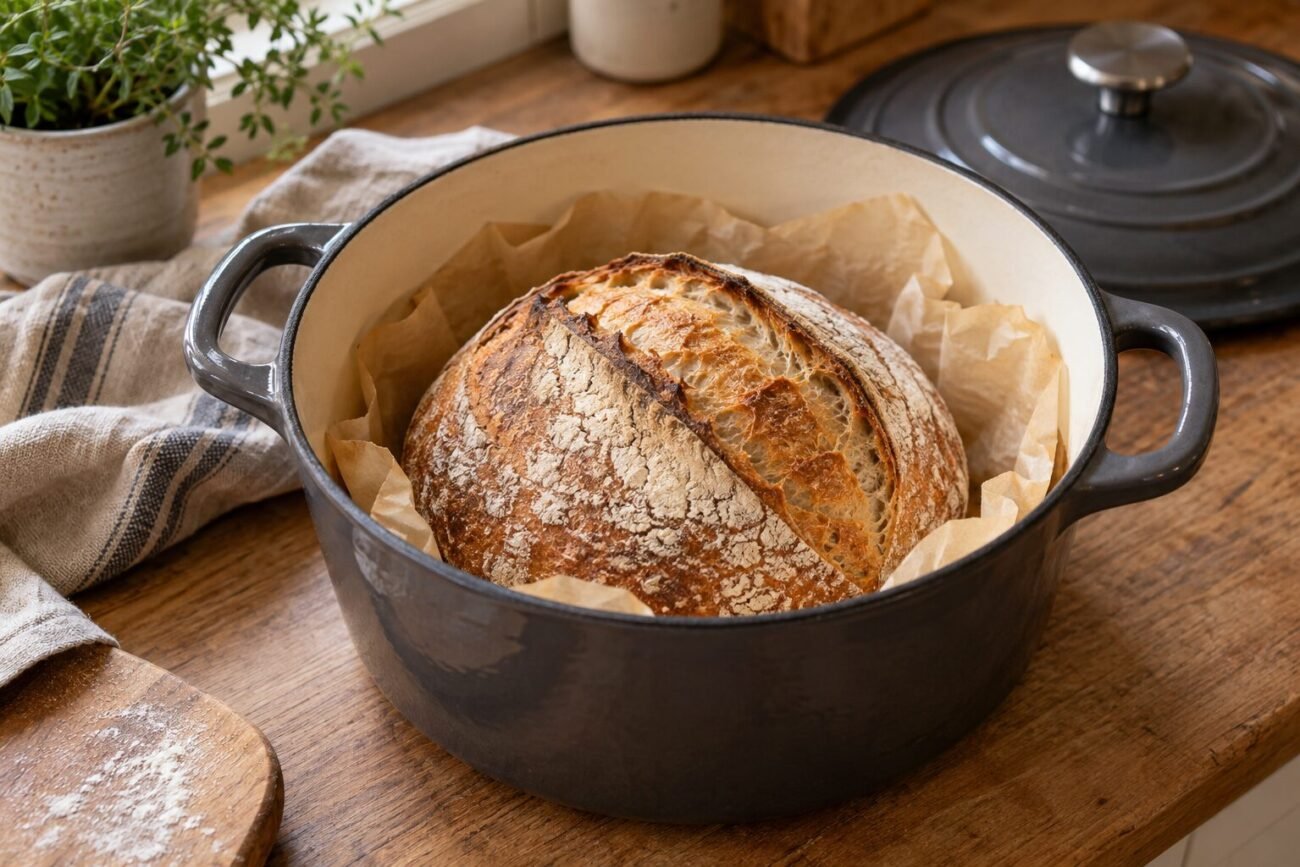
A loaf can look perfectly proofed right up until the pot suddenly seems too small.
I know that last-minute panic: the dough is ready, the oven is blazing, and I’m staring at the Dutch oven wondering if this boule is about to be an awkward fit. If the pot is too tight, oven spring can feel a bit cramped; if the opening is narrow, loading the loaf neatly gets much harder.
What makes it confusing is that quart labels are weirdly abstract. A 4.5-quart pot and a 6-quart pot can sound close on paper, but in use, that extra width or lid height can mean easier transfers, better headroom, and less fear that I bought the wrong size.


What a normal boule looks like
When I say a normal boule, I usually mean the everyday home loaf built from about 500 g of flour. Once I add water, starter, and salt, that usually turns into roughly 750–900 g of dough. After baking, it often finishes around 8–10 inches across, depending on hydration, shaping, and oven spring.
That’s why I don’t treat the quart label as the whole story. For actual fit, I care more about the loaf’s diameter and the pot’s headroom than the advertised volume.
- Base width affects whether the loaf spreads naturally or feels squeezed.
- Lid clearance affects how much room the dough has to rise and open along the score.
- Opening width affects how easy it is to lower the dough in without awkward handling.
A pot can sound roomy on paper and still feel tight if the walls push the loaf upward or the lid sits too close. If you want another reference point, I’d compare that with how to match pot size to a beginner boule.
- Useful range A round 4.5- to 5.5-quart Dutch oven fits most 750–900 g boules well.
- Safe default If I had to pick one size, 5 quarts is the safest middle.
- Why it matters Too small creates loading and rise issues; a bit larger is usually easier to work with.
The easiest size answer
If I wanted one simple recommendation, I’d start with a round 4.5- to 5.5-quart Dutch oven. For a normal home boule, 5 quarts feels like the least risky middle ground.
A loaf in this range usually has enough floor space to land neatly and enough lid height to expand. When the pot is too small, the problems are pretty immediate:
- the dough can crowd the sides
- loading gets fussier
- oven spring can feel constrained
- the loaf may bake into a tighter, taller shape than intended
Extra room is usually more forgiving. You still get the covered, steamy bake that helps with rise and crust, but with less risk of the loaf feeling cramped. In my experience, being a little oversized is often easier to live with than being a little undersized.
I’d usually lean slightly larger, especially if both options are close. Just make sure the opening isn’t unusually narrow for its quart rating.
Use measurements, not quarts
-
Measure floor
-
Check widest width
-
Confirm lid height
-
Note wall shape
Reading Dutch oven fit
Baker Bettie compares shapes and openings, which can make listings much easier to decode.
This is why size advice looks inconsistent online: two Dutch ovens with the same quart label can still fit bread differently. One 5 qt pot may be wide and easy to load, while another is narrower or has less lid clearance, and brands can be a little loose about how they state capacity.
-
Around 700–850 g dough
This size usually sits comfortably in a true 4.5–5 qt round pot, especially if the base is roughly 8.5 inches wide or more.
-
Around 850–1000 g dough
This is the range I think of as a typical home boule. A 5–5.5 qt round oven often gives easier loading and a bit more room for oven spring.
-
Around 1000–1200 g dough
This can start to feel more natural in a 5.5–6.75 qt pot, particularly for taller proofs or doughs that do not spread much before baking.
If your formula lists only flour weight, 500 g flour often works out to roughly 800–900 g total dough, depending on hydration and add-ins.
Shape changes the fit
-
Round vs oval
A standard boule usually sits more naturally in a round oven.
Look forRound base that matches the loaf’s footprint.AvoidNarrow oval interiors that press the sides. -
Straight vs flared walls
Straight sides preserve floor space; heavy flare can hide a tight base.
Look forFairly vertical walls from base upward.AvoidPots that taper inward near the bottom. -
Low vs tall
Lower, wider pots are often easier for me to load, if lid height is decent.
Look forWide opening with good headroom.AvoidShallow lids that crowd oven spring. -
Tall and narrow
Some tall pots have enough quarts but still feel cramped where the loaf lands.
Look forInterior width sized to your proofed dough.AvoidQuart numbers without base measurements.
I’d happily use an oval oven for a batard. For a classic boule, though, round usually feels less fussy and more forgiving.
Choose the size you’ll actually use
Once I stopped thinking in quarts alone, the decision got much easier: I’d match the pot to my baking routine, not just the loaf.
- If I wanted one Dutch oven for everything, I’d lean toward a 5 to 5.5 qt round. That size usually leaves enough room for a normal boule, while still feeling practical for everyday cooking.
- If I already had a 6 qt round, I probably wouldn’t replace it just for sourdough. A standard boule generally bakes fine in it; the main trade-offs are extra weight and a slightly less snug steaming environment.
- If I mostly bake smaller loaves, a 4.5 to 5 qt often makes more sense. For 500–700 g dough, it can feel easier to handle, less bulky to preheat, and better matched to the loaf’s footprint.
I’d only lean larger if I regularly bake 900 g+ dough or I’m dealing with a pot that loses usable space through sloped walls or a low lid. I’d lean smaller if I value a lighter pot and rarely make anything bigger than a compact weekly boule.
So the “right” size depends less on a universal rule and more on whether I’m buying my first pot, using a 6-quart I already own, or baking small on purpose.
A comfortable one-pot pick
If I wanted one pot for mostly standard boules, this 5-quart round oven is close to the size I’d reach for first. The enameled cast iron body should hold heat well, and the tight dome lid—with about 4.92 inches of height—adds welcome room for oven spring. I also like the smooth white interior for easier flour spotting and cleanup.
For the usual 750–900 g dough, a round 5-quart pot tends to balance fit and forgiveness. It’s roomy enough for loading without crowding the loaf, but still useful beyond bread for soups, stews, or small braises.
If I already owned a 6-quart round oven, I’d try it before replacing anything. Extra space around a standard 8–10 inch boule usually doesn’t ruin the bake; it mainly gives you easier loading and a little more lid clearance. A model like Lodge’s enameled 6-quart is oven-safe to 500°F, heavy enough to hold heat well, and roomy enough to double as everyday soup-and-braise cookware. The main tradeoff is weight, not poor bread.
For the compact loaves I make most often—around the lower end of the 700–850 g dough range—a 4.5-quart round oven like Lodge’s can feel nicely proportioned. The smaller chamber helps keep the loaf centered, and it still covers the basics I look for in bread baking: heavy cast iron, even heat retention, a moisture-locking lid, and oven-safe enamel up to 500°F.
The compromise is breathing room. Loading gets a bit tighter, lid clearance can feel slimmer with taller dough, and it leaves less flexibility if I later want to scale up or use the pot for bigger all-purpose cooking jobs.
Last-minute fit checks
Will a 6-quart pot be too big?
Usually not. I mostly notice easier loading and extra weight, not worse bread.
Can an oval oven work?
Sometimes. A round boule can fit awkwardly if the base narrows or the lid sits low.
Is 4.5 quarts still enough?
Often, yes, for compact boules. It just leaves less room for expansion and future loaf size.
Do I need an exact quart match?
Not really. I’d trust interior width and lid clearance before I trust the box label.
My simple store rule
If I’m shopping for a normal boule, I start around 5 quarts. Then I check the usable interior width and lid clearance, because those two details usually tell me more than the quart number.

Really appreciate the “choose the size you’ll actually use” section.
A lot of bread advice ignores that some of us are also trying to make soup, stew, pasta sauce, whatever, and don’t want five giant pieces of cookware. If I mostly cook for two and bake one boule a week, would a 5 qt still be your default over a 4.5 qt?
I’m tempted by the smaller one because storage space is not exactly abundant in my kitchen.
For that use case, I’d still lean 5 qt as the default if you’re buying just one pot. It gives you a little more flexibility for both bread and everyday meals without jumping into the extra heft of a 6 qt.
That said, if your loaves stay compact and kitchen space is a real constraint, a 4.5 qt can absolutely be the more practical choice. It’s less about right vs wrong and more about how much breathing room you want.
Storage was my tie-breaker too. I went 4.5 qt and don’t regret it, but I also never make bigger doughs than about 700 g.
This was actually helpful because I kept comparing 4 qt vs 5 qt like the number alone would answer everything. I didn’t realize two pots with the same quart label could have different opening widths.
If my dough is usually around 800 g, would you personally call 5 qt the “don’t overthink it” size?
I wish more reviews talked about wall shape like you did here.
I almost bought a narrow oval because the quart number looked fine, but my gut said a round boule in a skinny oval was asking for trouble. Is it fair to say shape matters MORE than the quart label in that case?
Yes — for a round boule, shape can matter more than the quart label. A narrow oval may technically hold the volume, but the usable width for a boule can be worse than a smaller round oven.
That’s why base width, opening width, and lid shape usually predict success better than the advertised capacity.
I learned this the annoying way. My 5 qt oval was “big enough” on paper, but loading a round loaf into it felt awkward every single time.
I’ve got a 6 qt round and always thought it was probably too big for a normal sourdough boule. Nice to hear that extra room mostly affects loading ease instead of ruining the bake.
Do you think there’s any downside at all to baking a 750–800 g dough in a 6 qt, besides the pot being heavier?
I’m still a little skeptical about the “4.5 qt is fine for compact boules” point.
Mine tend to spread a bit during loading even when the dough is decent, and a snug pot makes me nervous because one awkward drop and it hits the side. Would you say 4.5 qt is more for bakers who are already pretty confident with handling?
That’s a fair concern. A 4.5-quart round can work well, but it gives you less margin for clumsy loading, dough that spreads a bit, or future bigger loaves.
So yes, in practice it often suits bakers who know they prefer compact boules or who are comfortable handling dough cleanly. For a more forgiving all-around choice, 5 qt is usually easier to live with.
I agree with this. My smaller pot bakes nice bread, but the stress level is weirdly higher lol.