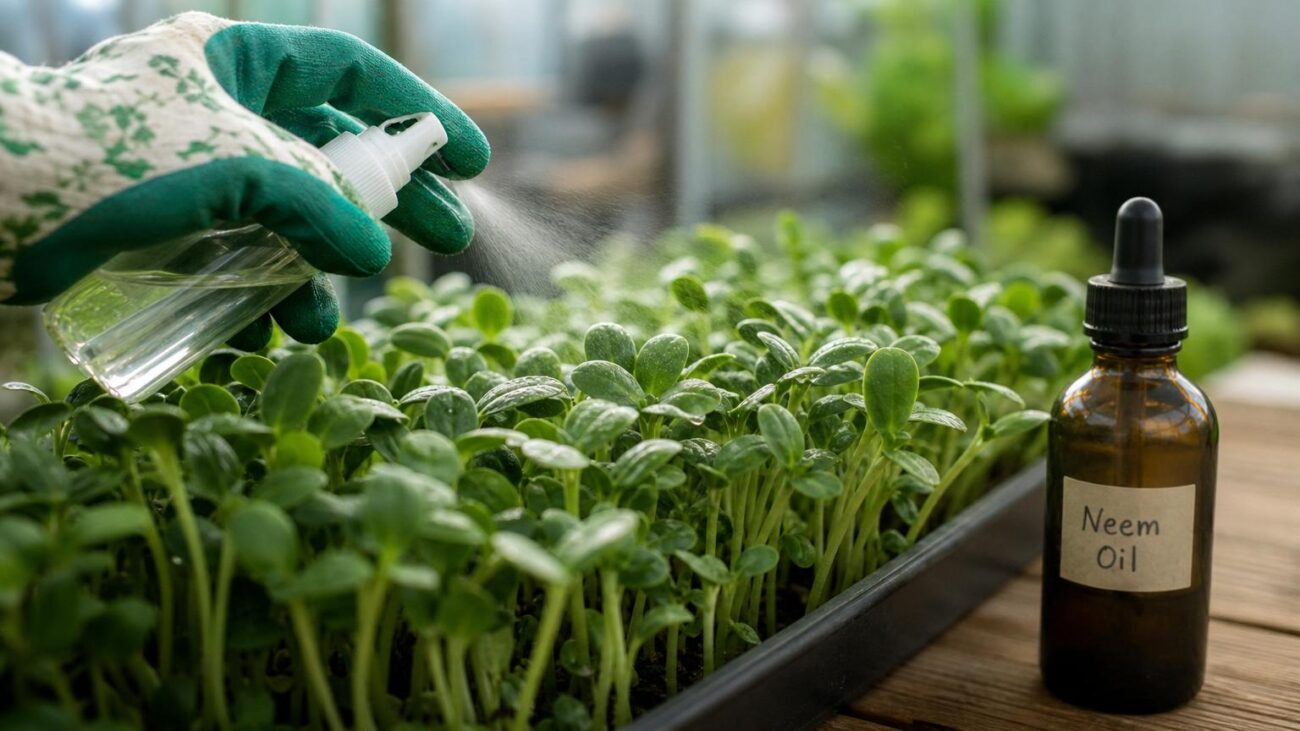
A last-minute aphid sighting can make a familiar spray bottle feel much less harmless.
Tiny insects appear just as the tray looks ready to cut, and that is exactly when neem starts feeling complicated. That hesitation is reasonable: microgreens are eaten young, often raw, with very little time for residue, smell, or leaf spotting to fade.
The short version is sometimes, but under tighter limits than many growers assume. Neem can be more workable early in a grow, but close to harvest it is often a poor fit. On tender edible greens, timing, dilution, and whether the crop will be washed matter a lot.
Common questions at the spray-or-harvest moment
Does plant-based mean low-risk here?
Not automatically. A natural spray can still leave residue, affect flavor, or stress delicate leaves.
When is neem more realistic?
Usually earlier in the grow, with a light mix and time before cutting. Near harvest, the margin for error gets small fast.
Why are microgreens different from houseplants?
They are harvested young and often eaten raw. Anything sprayed has less time to break down or rinse away.
Is one pest sighting enough to justify spraying?
Not always. On nearly finished trays, some growers tolerate minor damage rather than add a late treatment.
Why neem gets trickier on microgreens
Why are microgreens less forgiving than mature plants?
Microgreens have thin, delicate leaves and very little bulk. A coating that might be minor on a full-size plant can feel heavier here, sometimes showing up as extra shine, limpness, or slowed growth.
Does the dense canopy matter?
Yes. Trays are often packed closely, so spray lands across many leaf surfaces at once and airflow is limited. That can let an oily film linger longer than it might on spaced-out garden plants.
Why does harvest timing change the picture?
Microgreens are cut young, often only days after a problem first appears. That leaves less time for residue, smell, or mild leaf stress to fade before harvest.
Is the edible surface the main issue?
Usually, yes. On some crops, treatments go on stems, outer leaves, or parts that are not eaten directly. With microgreens, the treated surface is typically the same tender tissue headed for the plate.
Does rinsing fully solve that?
Rinsing can remove some surface oil, but not always evenly. Tender greens also bruise easily, so heavy washing may trade one issue for another.
A mature plant can often outgrow a rough spray. Microgreens usually cannot. Because the crop is short-lived and almost all leaf, even a light treatment can feel more noticeable than it would outdoors on larger plants.
The label matters more than the word “neem”
The useful clues are the crop list, use directions, and any harvest timing on the back label.
Different neem products are sold for different jobs. Some mention edible plants and give food-crop directions; others are aimed at houseplants or landscape use only.
Small label details can change whether a product fits an edible tray crop.
Check for dilution rates, how often it may be applied, and whether a pre-harvest interval is listed. On a crop cut young, even a short wait can be a big deal.
Ornamental-only wording is a strong sign that the bottle is not intended for something about to be eaten.
Microgreens are harvested fast and eaten whole above the soil line. If edible-crop instructions are missing, the safer reading is that the label does not support that use.
Before the product name, scan for four things:
edible crops listed any pre-harvest interval dilution directions ornamental-only wordingIf those points are unclear, the bottle is not giving much confidence for a short-turn edible crop.
If a tray was already sprayed, what now?
What is the first thing to check after spraying?
Start with the bottle, not the memory of what was mixed. The useful clues are whether it is labeled for edible crops, any harvest interval, and whether the product is meant only for ornamentals. If that wording is missing or unclear, confidence drops fast.
Does timing before harvest change the answer?
Usually, yes. A light spray applied several days before cutting leaves more room for residue, smell, and leaf sheen to fade than a same-day treatment. With microgreens, the short growing window makes late applications feel riskier than they would on longer crops.
Does the amount sprayed matter?
Quite a bit. A fine mist on stems or the tray edge is different from leaves that were visibly wet, glossy, or dripping. The heavier the application, the harder it is to shrug off residue concerns, especially on delicate greens eaten raw.
If the greens are washed well, is that enough?
Washing can remove dirt and some surface oil, so rinsing microgreens before eating still has value. But washing does not automatically settle the question, because the label, timing, and spray heaviness still shape how comfortable a person may feel harvesting that tray.
If the label clearly supports edible crops and the spray was light with a little time before harvest, the situation may feel more reasonable. If the label is vague, the spray was heavy, or harvest is immediate, caution tends to rise.
What can work instead of a late neem spray?
What can replace a last-minute neem spray?
For trays close to harvest, non-spray steps usually leave less on the crop. Sticky cards, better airflow, and a drier surface often help more than another coating.
Which prevention steps matter most?
Clean domes, weights, scissors, shelves, and trays between rounds. Old roots, seed hulls, algae, and constantly wet mats often give gnats and mold an easy start.
Does airflow really make a difference?
Gentle air movement can shorten leaf-wetness time and reduce stale, damp pockets. It also helps trays dry more evenly after watering.
When is discarding a tray the smarter call?
If a tray is heavily moldy, collapsing, or busy with pests, rescue can get messy fast. Starting over is sometimes the cleaner choice for an edible crop.


A simple caution-first filter
-
Check the bottle, not the ingredient
A tray is a possible fit only when the product label clearly covers edible crops and gives a usable harvest interval, dilution, and application direction.
-
Look at the calendar
The closer harvest is, the less room there is for odor, residue, or leaf stress to settle down. Near-cut trays usually deserve extra caution.
-
Think about how much landed on the leaves
A light, targeted application is different from a heavy coating on dense greens. More oil on edible surfaces usually means more cleanup, and cleanup has limits.
-
Factor in comfort with tradeoffs
Even when a label fits, some growers still dislike the idea of washing treated microgreens or tasting possible neem notes. That personal line matters as much as the spray math.
-
If any part feels shaky, pass
This follows the broader safety guide for treating microgreens: when label fit, timing, and residue comfort do not all line up, skipping neem on that tray is often the easier call.
Rather than treating neem as always fine or always off-limits, it helps to run a short filter: label fit, time before harvest, how heavily the leaves were coated, and comfort with washing, flavor, or residue tradeoffs.
When all four look reasonable, the risk picture is calmer. When even one looks doubtful, caution usually points away from spraying edible microgreens that are close to harvest.

I sprayed a radish tray once because fungus gnats were getting ridiculous, and the leaves had that weird smell for longer than I expected. I rinsed them, but the taste still felt… off.
So yeah, your point about washing having limited value matched my experience exactly.
My issue is the “discard decisions” part. Easy to say, harder to do when seed prices keep going up lol.
I get the safety-first angle, but I wish there was more practical guidance for small growers trying to salvage borderline trays without feeling reckless.
Maybe dumb question, but what counts as a “heavy” spray here? Like a fine mist until leaves glisten, or are we talking actually dripping wet? I think a lot of us accidentally overdo it because pests are stressful 😅
Not a dumb question at all. For microgreens, I’d think of “heavy” as anything beyond a light, even coating—especially if droplets collect, leaves stay visibly wet, or runoff reaches the media. On such tender crops, the difference between a light mist and an over-application matters a lot because residue, odor, and leaf stress become more noticeable fast.
Something I didn’t see mentioned much: do different microgreens react differently to leaf spotting after sprays? Brassicas seem tougher in my trays, but basil acts offended by everything.
Would be nice to know if some varieties are just bad candidates from the start.
Yes, species can differ quite a bit in how they handle foliar treatments. Texture, waxiness, leaf thickness, and how densely the tray grows all affect how a spray sits on the surface and whether stress shows up quickly. Basil and other tender types often give you less room for error than sturdier brassicas.
Honestly I appreciate that this article didn’t do the usual “neem is natural so it’s always fine” thing. Natural gets used like a magic word online.
I’ve lost pea shoots from foliar damage before, not even from neem specifically, just from stuff sitting on the leaves too long in a packed tray.
One thing I still wonder: if the label says it’s okay on edible crops, does that automatically include microgreens? They’re technically the same plant, but the part you eat is basically the whole tray of baby leaves.
Feels like companies write labels for full-size veggies and just leave us to guess on the tiny stuff.
Not automatically, and that’s the tricky part. A label that allows edible crops is a better sign than ornamental-only wording, but microgreens still create a different situation because the treated surface is the harvested product and the crop cycle is so short. If the label gives no clear harvest interval or the timing is very tight, caution still makes sense.
Would you personally toss a tray that was sprayed 2 days before harvest if the label was vague? That’s the real-world scenario I keep ending up in.
I know nobody wants to waste food, but I also don’t want to serve something bitter or questionable to my family.
If the label were vague and harvest was only 2 days away, I would lean toward not eating that tray. That’s especially true if the application was more than minimal or the greens are the kind that hold residue and odor easily. It’s frustrating to discard a tray, but with microgreens the margin for “maybe it’s fine” is pretty small.
This is why I stopped treating near-harvest trays with basically anything. If I’m at the spray-or-harvest moment, I usually just harvest what looks clean and compost the rest.
Not saying that’s economical 😂 but it’s better for my stress level.
For the alternatives section: have you found bottom watering helps reduce the pest pressure enough to skip sprays altogether? I switched from overhead and it definitely cut down on some issues, but not all.
Airflow helped more than I expected tbh.
Bottom watering helped me a lot with sunflower and broccoli, mostly because the canopy stayed drier. Didn’t solve aphids for me, but it made mold/funky tray conditions way less common.