
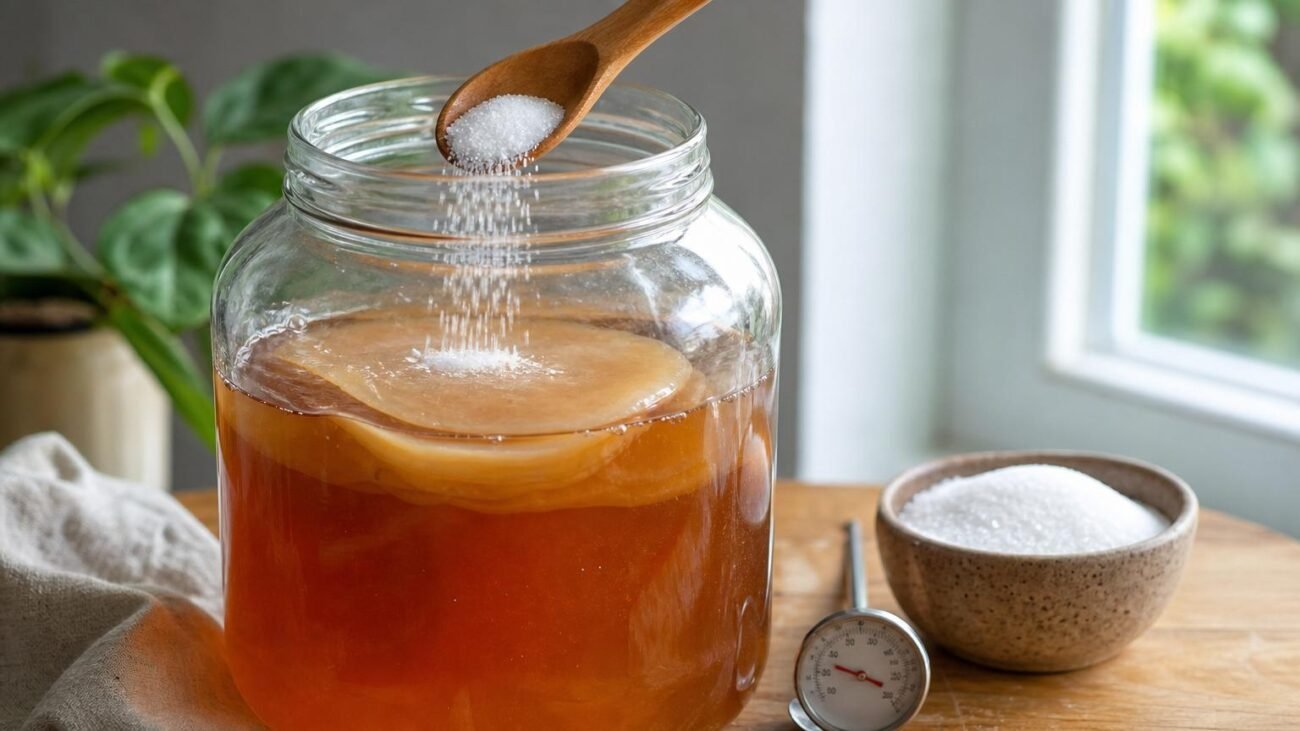
Your SCOBY needs enough food, not magic.
Ever compare two kombucha recipes and worry your SCOBY will starve if you choose the lower-sugar one? I’ve had that moment too. In my experience, kombucha is usually less delicate than conflicting recipes make it seem.
What matters most is a workable range. For first fermentation, the sugar needs to feed the yeast and bacteria long enough for the tea to turn pleasantly tart. If the amount drops too far, fermentation can slow or feel uneven, but you do not need folklore-level precision to keep a healthy brew moving.
- Many home brewers begin around 3/4 to 1 cup sugar per gallon of tea.
- That equals roughly 150–200 g per 3.8 L batch.
A dependable starting amount
What’s actually using the sugar
SCOBY
When I say SCOBY, I mean the whole living culture: yeast and bacteria in the tea, plus the starter liquid. That full community is what keeps fermentation going.
Pellicle
The rubbery layer on top is a pellicle, not the entire culture. It’s more like a cellulose byproduct and protective raft than the main thing “eating” the sugar.
Yeast
Yeast gets first crack at the sugar. It breaks sucrose into simpler sugars and creates alcohol and carbon dioxide along the way.
Bacteria
Bacteria then use some of those yeast-made compounds to produce acids. That shift is part of why kombucha tastes less sugary as it matures.
Starting sugar vs. finished sweetness
These are not the same measurement. A batch can begin with plenty of sugar for fermentation and still finish only lightly sweet, depending on time, temperature, and culture activity.
Scale sugar to the jar you’re actually using
-
Keep one baseline in mind
I find it easiest to remember one anchor: about 3/4 to 1 cup of sugar for 1 gallon of sweet tea. From there, I just shrink or expand the amount with the jar size instead of hunting for a new recipe each time.
-
Use the common jar shortcuts
For a quart, that works out to about 3 to 4 tablespoons. A half-gallon lands at 6 to 8 tablespoons, and 2 gallons comes to 1 1/2 to 2 cups.
-
Turn cups into tablespoons when it helps
This is the kitchen math I actually use: 1 cup = 16 tablespoons, so 3/4 cup = 12 tablespoons. Once I know that, quartering or halving the sugar feels much less fussy.
-
For in-between sizes, think in fractions of a gallon
A 2-quart jar is a half-gallon, so I use the half-gallon amount. A 3-quart jar is 3/4 of a gallon, so about 9 to 12 tablespoons usually matches the same starting range.
-
Close counts
Kombucha usually doesn’t need lab-level precision. If your spoonful is slightly rounded or your jar is a little shy of full, staying near the same ratio is often good enough for a consistent first ferment.
Easy reference: quart 3–4 tbsp; half-gallon 6–8 tbsp; gallon 12–16 tbsp; 2 gallons 1 1/2–2 cups.
Dissolve the sugar, then keep the source simple
Why dissolving matters
I’ve found the sugar amount only works as intended when it’s fully dissolved into the sweet tea before the SCOBY goes in. If crystals are sitting on the bottom, parts of the brew can start with more food than others, which makes first fermentation feel less consistent.
I usually stir the sugar into hot tea until the liquid looks clear and I can’t feel grit on the spoon. That small step can make it easier to make your first kombucha batch without wondering whether the starter is unevenly fed.
Keep the sugar source predictable
For early batches, plain white cane sugar tends to be the most predictable choice. It dissolves easily, and it gives the yeast and bacteria a straightforward food source without adding extra variables.
Brown sugar, coconut sugar, honey, and syrups can all behave a little differently because they bring in other compounds along with sweetness. Those ingredients can be fun to test later, but when I’m aiming for a steady first ferment, I usually keep the tea and sugar combination simple.
Before cooling the tea, look for a clear liquid with no sugar layer at the bottom. If you see crystals, stir a bit longer.
Let fermentation tell you
I usually judge sugar sufficiency by what happens over several days, not by one moment on brew day. If the tea starts clearly sweet, then gradually tastes less sweet and more tangy, that’s a good sign the yeast and bacteria are actually working through the sugar. In a warmer kitchen, I may notice that shift sooner; in a cooler one, it can take longer.
A quick check can help more than staring at the jar. I start tasting after a few days and look for a pattern rather than a single dramatic change.
- Taste: sweetness begins to soften, with a mild tart edge showing up
- Aroma: tea-like sweetness gives way to a light vinegary or fruity smell
- Bubbles: a little fizz or tiny bubbles may appear, though some batches stay fairly quiet
- Surface: a new pellicle may form, but thickness or shape can vary a lot
None of those signs proves success by itself. I’ve had active batches with barely any visible pellicle, and I’ve seen odd-looking tops on brews that still turned out fine. What matters most is the overall direction: less sweet, more tart, day by day.
If a batch stays very sweet for many days, it can suggest slow fermentation, often from cool temperatures or a weak starter rather than sugar alone.
Sweet Doesn’t Always Mean You Used Too Much Sugar
A reasonable starting ratio can still leave sweetness behind when fermentation is simply moving slowly.
In my batches, cooler room temperatures often stretch things out. The sugar may still be noticeable not because there was too much, but because the culture has had less time to work through it.
Sometimes the ratio is fine, but the starter tea was weak or the inoculation was smaller than usual.
If the starting liquid is less acidic or the culture begins sluggishly, yeast and bacteria can take longer to get going, so the brew stays sweeter at perfectly ordinary sugar levels.
Often the more useful question is whether it needed more time, warmer conditions, or a stronger start.
Before changing the sugar, it can help to troubleshoot a batch that stays sweet. Cutting sugar too soon can make the next brew less predictable without fixing the real slowdown.
Very Sour Doesn’t Usually Mean You Started Too Sweet
More often, it simply fermented past my preferred balance.
Sugar sets the starting fuel. The strong vinegar note usually shows up later, after microbes have had extra time to turn sugars and alcohol into acids.
Earlier tasting often matters more than cutting sugar hard.
In my experience, batches swing from pleasant tart to sharp fairly quickly. If I’m trying to keep kombucha from getting too vinegary, checking sooner helps more than underfeeding the brew.
It may just have had enough time to keep acidifying.
Even a normal sugar range can finish quite dry and acidic if left long enough, especially in warm conditions.
Keep your starting point simple
- Begin near 3/4–1 cup per gallon, then adjust in small steps.
- A tiny brew log can make later batches feel much more predictable.
I’ve had the calmest results when I start close to the usual ratio and avoid big jumps. If a batch finishes sweeter or sharper than I wanted, I tweak the sugar a little next time instead of overcorrecting.
A quick note helps more than I expect: batch size, sugar amount, room temperature, start date, and a short taste note. After a couple of rounds, the pattern gets easier to read, and brewing feels less like guesswork.

Question on scaling: for a 3-quart jar, are you basically treating it like 3/4 of a gallon and using around 9 to 12 tablespoons?
I think that matches what you wrote, but I always second-guess myself when converting cups to tablespoons. Math and fermentation together is a dangerous combo in my kitchen.
Yes, that’s the idea. If your gallon baseline is 3/4 to 1 cup, then 3 quarts would be about 9 tablespoons to 12 tablespoons.
If you want the most predictable starting point, begin near the middle of that range and adjust only a little from batch to batch.
That’s what I do for my 3-quart jar and it’s been solid. I usually land at 10 tbsp and call it good.
Step-wise this is where I was messing up: I wasn’t fully dissolving the sugar before adding tea to the jar.
I know, sounds basic, but I’d end up with sugar kind of settled at the bottom and figured it would sort itself out. Maybe it does eventually, but my batches were inconsistent and one got way more sour than the others. Since dissolving it completely first, the first ferment has been much more even.
Small thing, big difference.
It does make a difference. Fully dissolving the sugar helps distribute it evenly right from the start, so the yeast and bacteria aren’t dealing with uneven access in the jar.
It’s a simple step, but it can definitely improve consistency.
Same here. I got lazy with that part and my brew times were all over the place. Annoyingly fixable problem lol.
I wish more kombucha articles said plainly that super sour usually means it just sat too long. People online act like every issue traces back to the exact sugar number.
Sometimes the answer is just “taste it sooner.” Revolutionary, I know.
I appreciate the emphasis on plain white sugar for first fermentation. Every other guide online makes it sound like using raw sugar or honey automatically makes you some kind of fermentation wizard.
I tried getting fancy once and the results were… educational. Predictable is underrated.
Exactly. There’s room to experiment later, but if someone wants a reliable baseline, simple white sugar is usually the easiest place to start.
It removes one variable, which makes troubleshooting much easier.
“Educational” is the nicest possible word for some of my old batches too 😅 Same lesson here.
The part about “sweet doesn’t always mean you used too much sugar” was weirdly reassuring.
My apartment gets cold, especially at night, and I kept blaming the recipe when the real issue was probably temp + me tasting too early. I had one batch that stayed sweet for over a week, and I was ready to declare it a failure. Left it a few more days and suddenly it got that nice tart edge.
So yeah, not every sweet batch is a sugar crime scene lol.
This actually cleared up why my kombucha kept stalling. I was trying to “go low sugar” and using like 1/2 cup per gallon because I assumed less sugar = healthier.
Turns out it just fermented super slowly and stayed weirdly sweet anyway. I went back to about 3/4 cup, dissolved it fully, and the batch was way more consistent. Annoying that the SCOBY wants snacks, but fair enough 😂